How Staples drove 91% daily adoption in just 3 weeks

Most frontline technology rollouts fail before they begin, not because the tool doesn’t work, but because the launch does.
You can deploy the most capable platform in your industry and still end up with low adoption, disengaged associates and a leadership team wondering what happened to the investment. The culprit, almost every time, is the same: treating a people problem like a technology problem.
Staples learned a different lesson. When their team set out to modernize how they communicate with and enable frontline associates, they made a deliberate choice: don’t launch a tool. Launch a change.
The result? 91% of Staples associates accessed Axonify daily within 3 weeks of go-live and they sustained that engagement for a full year. Then, one year later, they applied the same playbook to an AI-assistant rollout and saw 2,400 questions answered on day one.
Here’s how they did it, and what you can take directly into your next frontline initiative.
In this article
Why most frontline rollouts stall and how Staples avoided it
The real problem isn’t
the technology
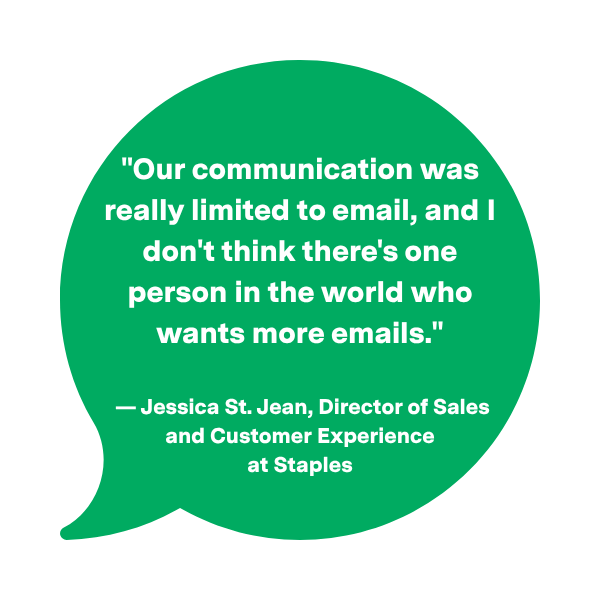
Before Axonify, Staples relied on an aging task management system and email-based communications. Measuring execution was difficult. Verifying completion was harder. And getting important information to associates in a consistent, timely way? Nearly impossible.
This is where most frontline organizations start. The platform you’re replacing may look different, but the underlying challenge, reaching frontline workers with the right information at the right time, is nearly universal.
What’s less universal is how organizations respond to it.
Jessica St. Jean, Director of Sales and Customer Experience at Staples, put the old model plainly:
Many organizations look for a new tool, assuming that alone will solve the problem. Staples looked instead at how change actually happens on the frontline. That distinction is what made the difference.
Treat the rollout as a change management initiative,
not a tech launch
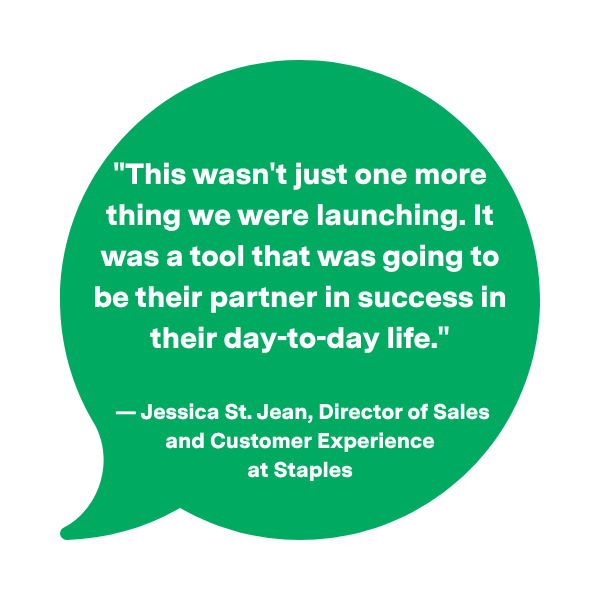
This is the foundational principle behind everything Staples did. Before a single associate logged in, the team had already spent eight to ten weeks building awareness, aligning leadership and seeding excitement across the organization.
That window wasn’t just spent on technical configuration or IT readiness. It was spent on the human side of the rollout: helping every layer of the organization understand not just what was coming, but why it mattered to them.
If you’re planning a frontline rollout, start your change management work well before go-live, not the week before.
3 things Staples did before launch day
1. Lead with what associates gain, not what’s changing
The fastest way to lose your frontline before you’ve even started is to frame a new tool as more work. Staples did the opposite.
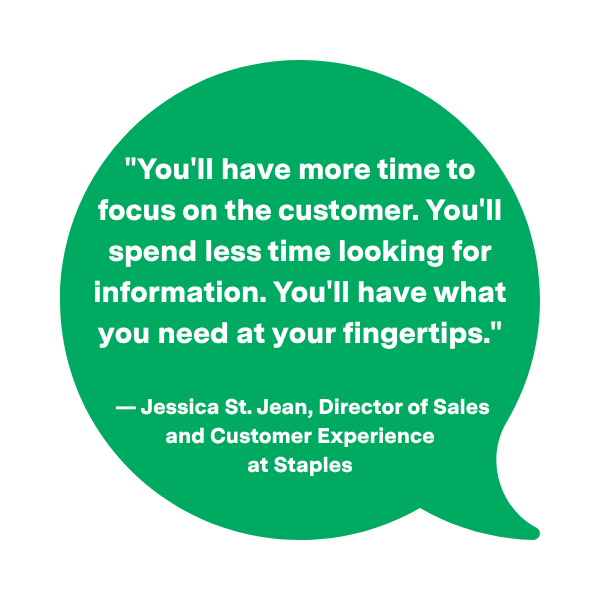
Their launch messaging centered on a simple, concrete value proposition for associates: this will make your job easier.
Notice what that message doesn’t say. It doesn’t lead with features. It doesn’t explain integrations or workflows. It speaks directly to the day-to-day reality of a frontline associate: time pressure, information overload and the constant interruption of looking things up.
When you’re crafting your own rollout communications, ask yourself: what does this mean for someone on a shift right now? If you can answer that in two sentences, you have your message.
2. Align every leadership tier before launch
Frontline adoption doesn’t start on the frontline. It starts with the leaders closest to associates and the leaders above them.
Staples aligned senior leaders, district managers and store managers around aggressive adoption goals and a unified vision before launch. By the time the platform was in associates’ hands, every layer of leadership was speaking the same language and reinforcing the same expectations.
This matters more than most teams realize. When a district manager communicates urgency around a new tool or initiative, store managers follow. When store managers follow, associates do too. That cascade only works if alignment exists at every level before the rollout begins.
Make sure your change management plan includes a deliberate sequencing of leadership conversations, starting at the top and working down to the people closest to the frontline. Don’t launch to all audiences simultaneously.
3. Build genuine excitement, not just awareness
There’s a difference between telling people something is coming and making them eager for it to arrive. Staples worked to create the latter.
Part of this came from the messaging itself. Staples framed the platform as something that works for associates. It also came from the tone leadership set throughout the pre-launch period: anticipatory, not procedural.
If you want that kind of buy-in, you have to invest in the narrative early. That means giving managers the language they need to have real conversations with their teams and not just sending a memo.
The results: what happens when adoption is earned, not assumed
Staples hit 91% daily adoption within 3 weeks of launch. More importantly, they didn’t lose it. That engagement was sustained for the full first year.
Here’s what came with it:
- 91% daily adoption within 3 weeks
- 91% daily engagement sustained over the first year
- 30% reduction in store task volume
- Measurable improvements in execution consistency
- The ability to directly connect task completion and store setup compliance to sales performance
The 30% reduction in task volume is worth pausing on. That’s not a vanity metric—it reflects a fundamental change in how work gets communicated and executed across the organization. When information reaches the right people at the right time, the volume of follow-up, re-communication and exception handling drops.
One year in: applying the same playbook to AI
Strong adoption isn’t a launch outcome. It’s the foundation for what comes next.
A year after go-live, Staples launched Max Assistant for frontline workers. And because they had already built trust with associates around the platform itself, they were able to introduce something genuinely new without starting from zero.
But they didn’t take that trust for granted. The Max Assistant launch was deliberately designed to create the same sense of excitement the original rollout had. The team introduced Max Assistant as if it were a new associate joining the company, complete with a name tag, cupcakes and a “Just Ask Max” campaign.
The result was immediate: 2,400 questions answered on day one.
What the Max Assistant launch teaches you about change
The Max Assistant rollout reinforces something the original launch already demonstrated: how you introduce a change shapes whether people use it.
You can have the most capable tool in your category. If associates don’t trust it, don’t know how to use it, or don’t see how it helps them, you won’t see that kind of day-one engagement.
Staples earned that engagement by treating the introduction like an event, something worth showing up for, not a feature update dropped into an existing system.
If you’re planning a rollout on the heels of a broader platform implementation, here’s what to take from the Staples example:
- Don’t assume adoption transfers automatically. Even in a high-adoption environment, new capabilities need their own introduction.
- Give the feature a personality. Max Assistant wasn’t just a new button—it had a name, a launch campaign, and a personality associates could relate to.
- Make it concrete at the point of need. “Just Ask Max” works because it tells associates exactly what to do and when. Remove the ambiguity.
The principle that ties it all together
Across the original launch and the Max Assistant rollout, Staples operated by a clear philosophy: change only sticks when people understand it, trust it and can see how it helps them.
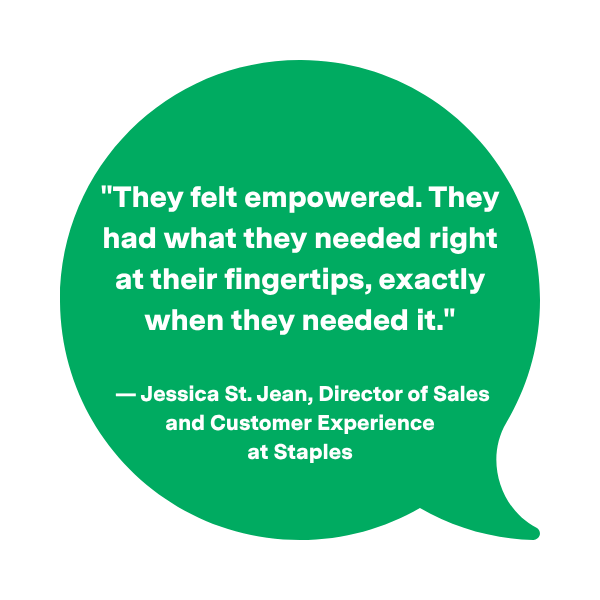
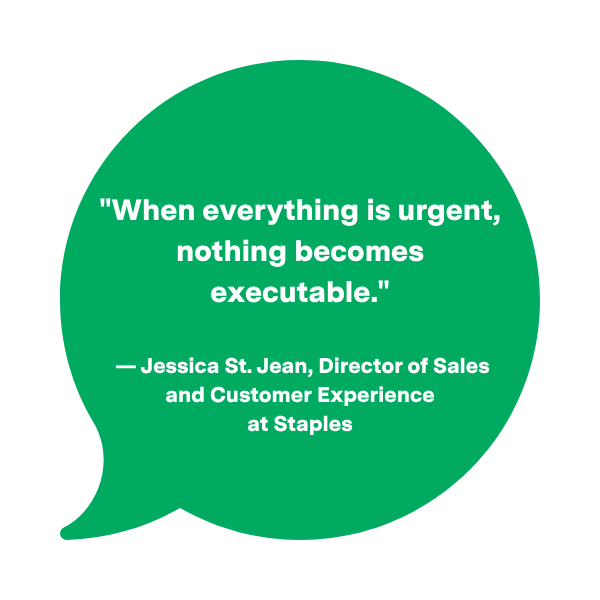
Jessica framed it simply:
That’s worth sitting with. If every initiative lands with the same weight and the same urgency, your frontline will learn to filter and the things that matter most will get lost in the noise. Clarity, sequencing, and genuine alignment at every level of the organization are what separate initiatives that get adopted from ones that quietly disappear.
Conclusion
What Staples built in three weeks didn’t happen by accident. It happened because the team understood that technology alone doesn’t drive adoption, people do. Getting people on board means starting early, leading with the right message and aligning every layer of leadership before a single associate logs in.
If you’re planning a frontline enablement rollout, or trying to unlock more from a platform you’ve already deployed, the Staples story is worth your full attention.
Watch the full webinar recording to hear Jessica St. Jean walk through the strategy, the execution and the results in her own words.