The staffing–training–tools triangle: Why your biggest problem is capacity, not staffing

The answer to “why aren’t things running smoothly on the floor?” almost always comes back to the same word: staffing. Ask frontline workers what makes their job harder, ask location managers what’s delaying execution, ask regional ops leaders why launches miss—staffing is at the top of every list. It’s the most cited barrier at every level of the organization.
And that consensus should give operators pause. Because when everyone’s pointing at the same problem, and the problem isn’t getting solved, it usually means the problem isn’t what everyone thinks it is.
The 2026 Frontline Operations Report, built from 1,594 frontline employees, managers and corporate leaders across retail, food service, hospitality and grocery, puts a different frame on it. Staffing is the loudest signal. But the actual constraint is capacity, and a significant share of lost capacity has nothing to do with headcount.
In this article
What frontline workers are actually telling you
When asked what most often makes it harder to do their jobs well, frontline workers ranked their blockers clearly. Short staffing led at 38.5% of mentions. Demanding customers followed at 24.1%. Missing tools or supplies came in at 11.4%. Then: too many changes (9.3%), not enough training (8.9%) and confusing messages (7.8%).
Read that list fast and the takeaway seems obvious: hire more people. But read it as a system and a different story emerges.
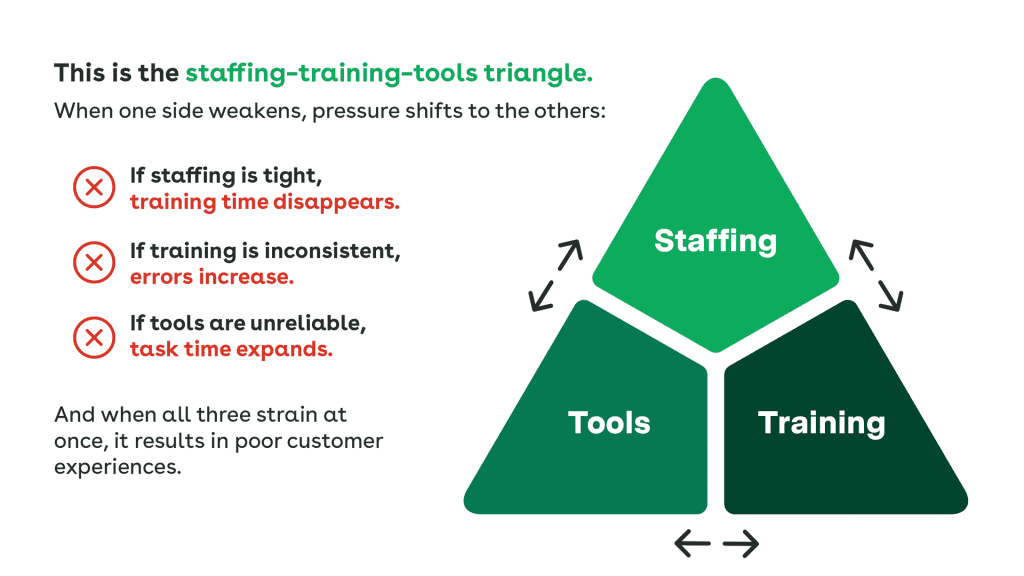
The fix isn’t found on any one side of the triangle. It’s in the operational infrastructure that connects all three, so pressure in one area doesn’t automatically drain the others.
The triangle works because the pressure doesn’t stay contained. Short staffing doesn’t just mean fewer hands, it means training time is the first thing sacrificed when someone calls in sick or a rush hits unexpectedly. Inconsistent training means more errors at the point of execution, which means more manager intervention, which means less coaching capacity for the next new hire. Unreliable tools stretch task time, which compounds the staffing constraint that was already there. None of this shows up in a job description. All of it shows up in your customer experience, and in the 38% rework rate your operation is quietly absorbing every shift.
The rework tax
Here’s the operational consequence of that triangle in motion: 38% of frontline workers say tasks often need to be redone because something was missed or unclear. In a constrained operation, that number isn’t just a quality metric—it’s a capacity tax.
Every task done twice displaces something that only gets done once. A shelf reset redone during peak hours means less floor coverage. A pricing error caught mid-promotion means inconsistent customer experience across locations. A repeated compliance task means a manager spending time on failure instead of coaching.
For a 500-location retailer, saving just five hours of rework time from one employee per location per week recovers 130,000 frontline hours and roughly $2.5 million in labor annually. Now imagine that number if it’s 38% of employees at each location, or more than five hours a week. That capacity already exists inside the operation. It’s just being consumed by execution breaks.
Where leadership misreads the problem
There’s a perception gap here that matters strategically. When asked what’s delaying task completion, frontline employees and location managers point to staffing at 52%–57%. Corporate leaders name unclear instructions as the primary driver (33%). That’s not just a disagreement, it’s a misdiagnosis that shapes where solutions get funded.
Clearer documentation, more detailed checklists, better instruction design: all reasonable investments. But if 52% of the delay is staffing-driven and you’re funding instruction clarity, you’re solving for the third-biggest problem while the first one stays in place. Meanwhile, the rework compounds.
This matters because the triangle isn’t three separate problems with three separate fixes. It’s one systems problem—capacity—that shows up differently depending on which side of it you’re standing on.
Training and tools aren’t extras—they’re where capacity lives
The data is direct about what makes frontline teams productive: on-the-job practice (51%), manager coaching (47%) and peer support (42%) are the top three methods cited for getting new hires productive faster. Notice what none of those are: formal programs, dense onboarding manuals or one-time training events.
They’re continuous. They happen in the flow of work. And every one of them requires capacity to deliver.
Shadowing requires someone with time to shadow. Coaching requires a manager who isn’t covering a gap. Peer support requires a team that isn’t in firefighting mode. When 46% of location managers report that new initiatives arrive without adequate support to execute well, they’re not just describing a communication problem—they’re describing an environment where the conditions for effective training are systematically unavailable at exactly the moment they’re most needed.
The tools side of the triangle has a similar dynamic. 18% of frontline workers cite missing tools or equipment as a task delay driver. But the deeper issue isn’t just absence of tools—it’s fragmentation. 54% of task assignments still happen verbally, with no verification and no visibility into whether instructions reached the floor. When systems don’t talk to each other, capacity leaks at every handoff.
The reframe that changes what’s solvable
The instinct when staffing is cited as a barrier is to look at the labor line. That’s an understandable instinct. But the data points toward something more actionable: a significant share of what looks like a staffing problem is capacity being lost to execution gaps—rework that consumes it, initiatives that land without support, communication that doesn’t reach the floor, training that disappears when managers are stretched.
Frontline workers score 4.68 out of 5 on role clarity. They know what good looks like. The gap isn’t motivation or understanding. It’s the operational infrastructure that determines whether they can act on what they know, consistently, at every location.
The staffing–training–tools triangle isn’t three items on a wishlist. It’s the shape of a capacity problem that’s recoverable, not by adding headcount, but by building the systems that stop consuming the capacity already there.