What ATD26 made clear about the future of L&D in frontline organizations

Five trends from Los Angeles, and what they mean for leaders building a frontline workforce
ATD26 drew thousands of L&D, HR, and operations leaders to Los Angeles, and this year, the conversation felt different.
The conference opened with Freestyle+, a group of Broadway performers, TED speakers and coaches using improvisation as a frame for leading under pressure. The point landed early. Talent development has to help people adapt, not only acquire knowledge.
If last year was about getting comfortable with AI, this year was about getting honest with it. The hype faded. The questions sharpened. And the real debate shifted from what AI can do, to what L&D needs to earn a seat at the strategic table.
5 Trends
Trend one: L&D is being measured like a business function
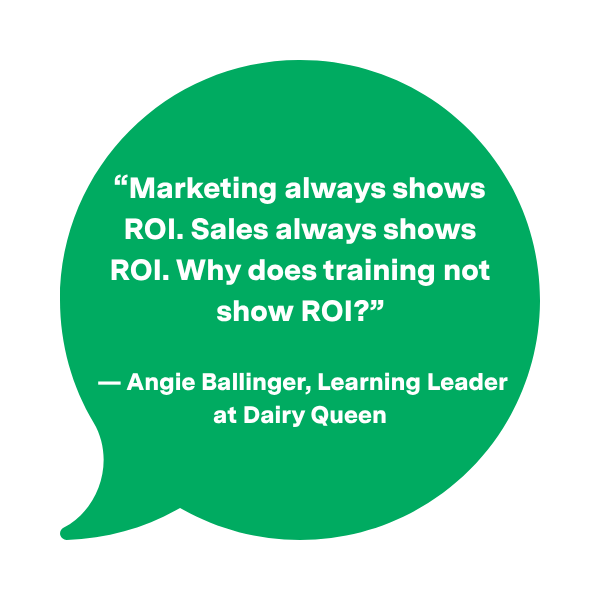
Completions, attendance and hours of training are no longer enough. Angie Ballinger, Learning Leader at Dairy Queen, put it bluntly during her session, Scaling Sweet Success: How Learning Fuels Dairy Queen’s Rapid Growth Strategy:
Ballinger’s team built Learning Impact Maps to tie every initiative to behavior, behavior to KPIs, and KPIs to Dairy Queen’s 10×30 growth goal, a target of 10 billion dollars in sales by 2030. Healthcare, food production, retail and restaurant operators across the week made the same case. L&D is being asked to speak the language of operators, finance and the executive team.
Build the business case before you build the content. Every program should answer two questions. Why are we doing this? How will it move the number your business cares about?
Trend two: When it comes to AI, strategy
beats hype
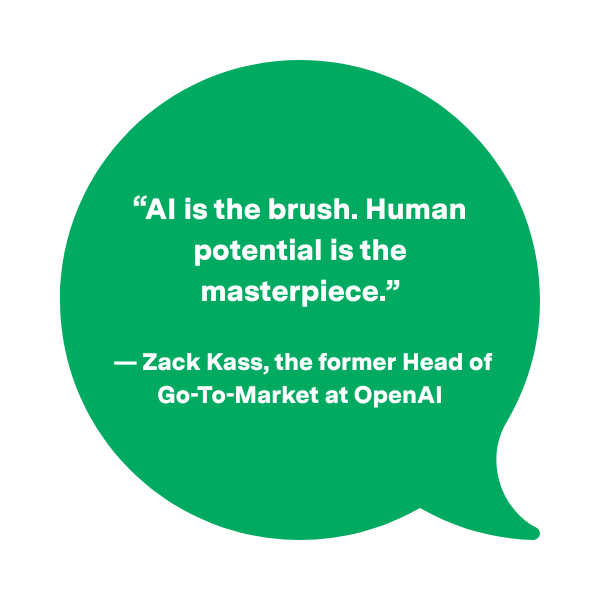
Zack Kass, the former Head of Go-To-Market at OpenAI, opened Monday with a line worth repeating:
His point was simple. AI will become a utility, like electricity. The differentiator will not be access to it. It will be what humans choose to do with it.
The message echoed across the EXPO floor. Vendors who two years ago led with “we have AI” have moved on. Now they lead with what the AI does. AI gets you to about 80 percent. The final 20 percent, the part involving organizational context, performance insight and human judgment, is where L&D earns its keep.
Stop chasing tools. Start with a business problem. Treat your prompts like project briefs. Keep humans in the loop where it counts. And ask how each new AI tool fits into your existing ecosystems. Point solutions which do not connect to your data create more debt than they remove.
Trend three: Content was never the goal. Performance is.
Content delivery is no longer the work. Skill building, coaching and in-the-moment performance support are.
AI roleplay tools across multiple sessions showed managers and frontline employees rehearsing high-stakes conversations, receiving rapid feedback, and trying again. Strong examples included NovoEd’s AI Role-Play and the Future of Performance Readiness, Learning Pool’s AI Simulations: Using Generative AI, Situated Practice, and Real-Time Feedback, and Tenor’s The Future of Leadership Development: Powered by AI. Across all three, the value was never the simulation. It was the practice cycle.
Dr. Alexandra Urban’s Coursera session Designing Learning That Sticks offered a five P audit I have been thinking about most since I got home. Her five P audit reframed retention as a friction problem, not a value problem. Use it as a quick check on your own learning environment:
- Prime. Do learners see relevance and value in week one?
- Pace. Is the workload segmented to fit working memory?
- Protect. Does challenge feel achievable instead of identity-threatening?
- Personalize. Is support available exactly where friction shows up?
- Propel. After each milestone, is the next step obvious and easy?
Her sharpest line on AI: scaffold learning, do not shortcut it. Scaffolding offers hints and coaching in the moment. Shortcuts skip to the answer and the learning never sticks.
A related warning surfaced in D2L’s session The Future of Work and Learning: The Impact of Generative AI on Entry-Level Work. As AI absorbs routine entry-level tasks, the early-career experiences where people once built judgment, communication and problem-solving are quietly disappearing. The fix is intentional. Rebuild practice, mentorship and reflection into the learning experience itself.
Invest in practice, not only in publishing. The next generation of L&D platforms will be judged on whether they help people perform.
Trend four: L&D must show its work
Move from leading indicators like completions to lagging indicators like operational outcomes. The same examples surfaced all week. Call avoidance. Digital adoption. Food safety. Speed to proficiency. Cost savings. UnitedHealthcare’s Drive to Digital program, presented with Intrepid Learning, measures success through exactly those outcomes, not learner NPS or completion rates.
A sharp data point from the D2L session and the supporting Future of Work and Learning white paper: 69 percent of HR leaders struggle most with filling human skills gaps, while 75 percent have no upskilling program in place.
If you are still presenting completion rates to your executive team, the conversation has moved past you.
Trend five: Stop adapting. Start designing for the frontline.
Frontline employees represent the majority of the working world, yet most learning systems were designed for desk-based knowledge workers. The mismatch is operational, not philosophical.
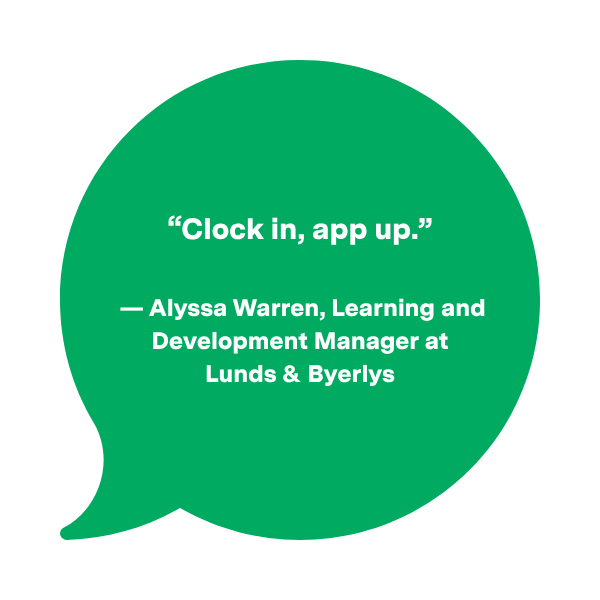
Alyssa Warren, Learning and Development Manager at Lunds & Byerlys, described how her team built their daily routine around four words during the Axonify-led panel From Learning to Execution: How Frontline L&D Can Align with Operations and Drive Results.
Before employees hit the floor, a few minutes inside the platform on the day’s priorities. Training stops being a separate task. It becomes part of getting ready for the shift. In 75,000 Frontline Workers, 14 Languages, 1 Migration, Shae Phelps-Peden and Courtney Walter from JBS described how the world’s largest food producer moved its frontline workforce onto a mobile-first platform with modules under 20 minutes. The result was a cut in training time from three days to two and a tighter connection between training and safety.
Will Guidara, the Tuesday keynote and author of Unreasonable Hospitality, gave the trend its emotional throughline. His framework depends on frontline execution. Managers who use huddles as inspiration. Employees who notice small customer cues. Systems which turn predictable moments into memorable ones.
Stop adapting corporate training for the frontline. Design for the frontline first.
Final reflection
Liz Wiseman closed the conference on Wednesday with a keynote on Leading Brilliantly Through the Dark. Her research on how the best leaders build teams which perform under disruption was the right ending for the week.
The L&D field is not being threatened by AI. It is being asked to grow up. Frontline organizations feel this shift the most. Their workforce is the bridge between strategy and execution. When learning works for the frontline, business outcomes follow.
At Axonify, we have spent years building for this reality. ATD26 confirmed something we already believed. The future of L&D belongs to teams who treat learning as performance infrastructure, who measure what matters, and who design with the frontline first.