The five-minute coach: How AI gives frontline managers time to coach and develop their teams
Ask any frontline manager what they’re actually responsible for and the list runs long: hitting targets, keeping the team compliant, driving customer experience and developing every associate on the floor, often all before lunch. Now ask them how much of that list they get to do well. The honest answer, most days, is not enough.
That’s not a knock on frontline managers. It’s a design flaw in how we’ve asked them to coach.
In this article
Why coaching comes last
Coaching at scale has always been difficult for managers to prioritize. Not because managers don’t care, but because coaching is always the thing that happens after everything else is done. Schedules get built, compliance gets checked, deliveries get received, customers get helped. If there’s a window left over, that’s when coaching happens.
The real barrier was never effort or intent. It’s knowing where to focus. A manager can want to coach every person on their team well and still not know, on any given day, who actually needs what help and why. Traditional coaching puts an enormous burden on managers to notice who’s struggling, find a window to intervene and do it consistently, across every associate, every shift, every week.
The data bears out why this has always been so hard. Gallup has found that managers account for roughly 70% of the variance in team engagement. That’s an enormous amount of business outcome resting on one person’s ability to notice the right thing at the right moment for the right associate, while also running the shift. Frontline managers are frequently responsible for dozens of people, a span of control that makes individualized, consistent coaching nearly impossible to sustain by observation alone. Add in the administrative load—schedules, compliance checklists, reporting—and it’s easy to see why coaching becomes the thing that happens when everything else is done. Which, for most managers, is never.
That’s exactly the piece we’re solving. Instead of asking a manager to already know where to focus, AI feeds them the answer: surfacing, from real performance and confidence signals, exactly who needs what and when. The effort of finding where to focus disappears; what’s left is the coaching itself.
What changes when AI does the noticing
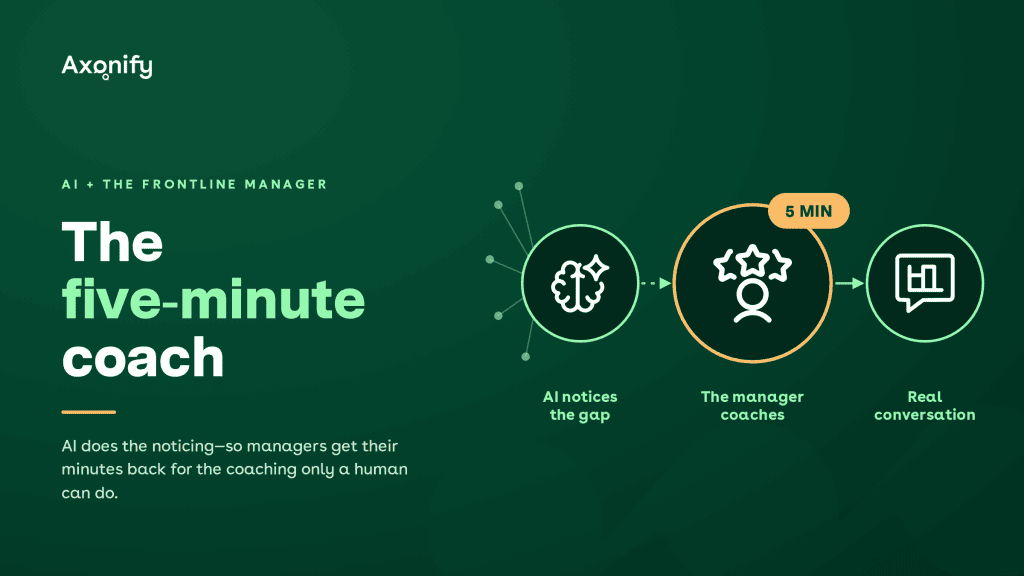
This is the shift worth paying attention to: AI doesn’t replace the manager as coach. It replaces the manager as the sole detection system.
Instead of waiting for a manager to notice a knowledge gap, a compliance miss, or a dip in performance, AI can identify it continuously, from real signals like quiz performance, task completion, confidence scores and on-the-job behavior and automatically assign the right piece of coaching to close that specific gap, for that specific associate, the moment it appears. The identification and the first-line intervention happen without the manager having to be in the room, on the floor, or even aware the gap existed yet.
That’s the fundamental reframe. AI handles the pattern recognition, the part of coaching that’s really a data problem. As a result, managers can spend their time on the part of coaching that isn’t: the conversation that requires judgment, empathy and context only a human can bring. A five-minute check-in with an associate who’s already received and worked through a personalized enablement path that closes learning gaps through reinforcement, builds confidence through AI coaching practice and has received targeted manager coaching to drive behavior change looks completely different than a five-minute check-in that has to start from “so, how’s it going?”
Managers who get this time back don’t spend it in more status meetings. They spend it having better coaching conversations, more of them, with the right people, at the right time. That’s the return: not just hours reclaimed, but hours reinvested in the moments where a human manager actually changes an outcome.
What proactive AI coaching looks like
in practice
Proactive coaching only works if the underlying system has a genuinely current and holistic understanding of what each employee knows, doesn’t know, can do and can’t do yet. Not a snapshot from a quarterly review, but a continuous read on capability and confidence.
That’s a materially different problem than tracking course completions. It requires a continuous stream of signals about readiness , not just “did they finish the training” but “do they actually know this, are they confident in it and can they perform it when it counts.” When a platform understands that level of nuance for every associate, it can adapt the coaching itself: what to assign, to whom and when, based on where that specific person actually is, not where the org chart assumes they should be.
In practice, that might mean an associate who’s technically “trained” on a new product but whose confidence scores suggest hesitation gets a short, targeted AI coaching session to help with reinforcement before their manager ever has to flag it. It might mean a team member who’s nailing execution but plateauing on customer interaction gets nudged toward a stretch assignment instead of more repetition of what they’ve already mastered. The system is doing the continuous work of knowing where every person stands so the manager’s five minutes go exactly where they’re needed.
Coaching gaps closed is only half the
job—development is the other half
Here’s where it’s worth pushing back on a narrow view of what AI coaching is for. If the only goal is closing performance gaps, you’ll build a system that’s very good at triage and not much else. Associates deserve more than triage.
But it’s worth being precise about who does the developing. People don’t want to be developed by an algorithm, they want to be developed by their manager and they want that manager to actually have what they need to do it well. The role of AI here isn’t to replace that relationship; it’s to arm it. The same continuous understanding of capability that lets AI identify a gap can also surface something more valuable: a real signal about where an associate is headed—the next skill, the next stretch opportunity, the readiness for more—and put that visibility directly in the manager’s hands, at the moment it matters, so the manager is the one having the conversation. Done well, that visibility has real shape to it: a skill progression or career lattice, associate to shift lead to department expert, for instance, with AI surfacing exactly who’s ready for the next rung so the manager doesn’t have to rely on memory or catch it by chance.
It’s also worth being precise about whose interests that conversation serves. Most coaching, even proactive AI coaching, is built to close gaps the business needs closed. A more complete model gives the manager two inputs at once: what the organization needs such as the skills a department is short on, the roles it needs to fill from within and what the associate wants like the cross-training they’re curious about, the stretch skill they’ve asked for, the direction they’d choose for themselves if anyone asked. An AI partner that surfaces both isn’t personalizing the destination on its own; it’s making sure the manager walks into that conversation with the fuller picture, for every person on the team, not just the ones who happen to catch their attention.
That distinction matters enormously to retention. Coaching that only shows up when something’s broken feels like correction. A manager saying “here’s where I see you going” feels like investment and it lands differently coming from a person who knows them than from a piece of software. Frontline turnover is stubbornly expensive and the research is consistent on what moves it: employees who feel like their manager and their organization are actively developing them stay longer and perform better. AI’s job is to make sure every manager has the visibility to have that conversation well, consistently, at the scale a frontline organization actually operates at while the manager still does the developing.
Why this requires a frontline-native approach
It’s tempting to assume the coaching tools built for corporate or professional sales teams will simply translate down to the frontline. They won’t. Frontline associates are motivated differently, scheduled differently and engage with technology differently than a desk-based seller working from a CRM. A coaching model borrowed from that world, built around email, long-form content and self-directed learning, doesn’t survive contact with a shift-based, mobile-first, no-desk workforce.
Getting proactive AI coaching right for the frontline means building for the frontline from the ground up: mobile-first delivery, bite-sized interventions that fit inside a break or a lull at the register and a continuous signal model tuned to how frontline work actually happens. It also means connecting the AI coach as connected to everything else the associate does using the same platform that trains them, guides their execution and surfaces insight to their manager rather than a bolt-on layer sitting on top of an unrelated system.
The manager’s time is the return
Strip away the technology and the value proposition here is simple: give managers back the minutes that used to go to noticing problems and let AI spend those minutes for them: continuously, consistently, across every associate on the team. What managers do with the time they get back is coach the moments AI can’t: the conversation that needs a human read on tone, the associate having a hard week, the judgment call that no signal can fully capture.
That’s the five-minute coach. Not five minutes instead of real coaching but five minutes that finally get to be real coaching, because the manager isn’t spending the other fifty-five just trying to figure out where to start.
The technology gives managers the time.
Enabling them to use it well is the next step.
Watch retail and grocery leaders from Longo’s, CoderPad and Retail Strategy Group break down how they enable store managers to coach execution at scale—building consistency across every shift and location, without adding to the noise.