AI-powered frontline enablement platform: how to close the gap between learning and execution
Axonify connects training to daily execution because two locations can run the same brand, the same training and the same tools—and still get different results. One hits every number. The other misses on service, on compliance, on sales.
The difference usually isn’t effort. It’s execution.
That gap between what you teach and what actually happens on the floor is the problem an AI-powered frontline enablement platform exists to solve. It’s also the gap most reporting hides, because a finished course looks identical whether or not the work got done right.
You’ve probably felt it. A new product launches, the training goes out and completion rates climb toward 100%. Yet the execution you expected never shows up at half your sites.
The plan was sound. The last mile broke.
In this article
Why your best and worst locations run the same playbook and get different results
An AI-powered frontline enablement platform is a single system that unifies learning, in-the-moment execution and real-time insights—with AI built into the architecture. It makes sure what corporate intends actually gets done on the floor.
Axonify is the AI-Powered Frontline Enablement Platform built for exactly this. It replaces the patchwork of a separate learning tool, a comms app and a task list with one connected loop. That loop trains workers, guides their work and shows leaders exactly who’s ready.
Here’s why your locations diverge. Headquarters ships a plan, a promotion or a new safety rule. Each site translates it on the fly, under pressure, during a busy shift.
The learning-to-execution gap is the distance between that plan leaving corporate and a worker doing it right on a Tuesday night.
Your strongest locations close that distance with great managers and institutional memory. Your weakest ones can’t, and no amount of extra content fixes it—because the problem was never a shortage of training. It was the handoff between knowing and doing.
From a dashboard, it stays invisible. Every store shows the training as “complete,” so the numbers look fine right up until a customer, an auditor or a safety incident proves otherwise.
This is why fixing the gap isn’t a content problem or a scheduling problem. It’s a connection problem. When learning, the work and the readiness signals live in separate tools, the thread snaps at the moment it matters most—on the shift.
The learning-to-execution gap is expensive and invisible from headquarters
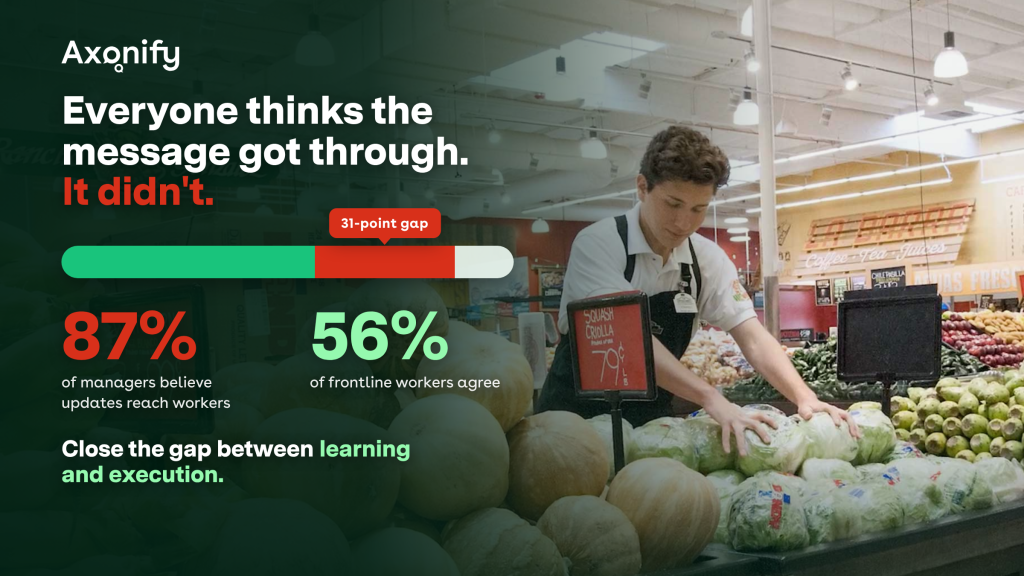
The gap is wide, and leaders rarely see it. Axonify’s 2026 Frontline Enablement Report found a 31-point gap: 87% of frontline leaders believe information reaches workers but only 56% of workers agree.
That gap sits beneath a huge slice of the economy. In a January 2026 analysis, McKinsey reports that “companies in sectors ranging from healthcare and retail to manufacturing, construction, and transportation employ some 100 million Americans.” When enablement breaks for that many people, the cost compounds fast.
It shows up first in churn. In a July 2026 report, the World Economic Forum reported that “Annual turnover in 2025 reached 87% in quick-service restaurants, 81% in retail, and 73% in logistics and warehousing,” while voluntary turnover costs US businesses roughly $1 trillion per year. Every departure resets the learning-to-execution loop to zero.
Then it shows up everywhere else—inconsistent service, avoidable errors, slower launches and compliance risk you can’t see coming. These costs rarely land on a training line item, so they hide in plain sight while the real driver goes unaddressed.
Inside an AI-powered frontline enablement platform: three connected pillars
One platform. Three connected pillars. Each one feeds the next, so today’s knowledge gap shapes tomorrow’s practice and this week’s coaching.
This is the structural difference between a platform and a stack of point tools. A stack makes you stitch the pieces together by hand and hope the data lines up. A connected platform does the stitching for you, which is what lets a rollout move from plan to proof without losing fidelity along the way.
1. Immersive Microlearning
Immersive Microlearning delivers short, personalized bursts of training in the flow of work. It uses behavioral science and adaptive reinforcement to close skill gaps and speed up time to proficiency.
Workers don’t just finish a module and forget it. They retain what matters, apply it on the job and come back daily because the experience fits their shift, not the other way around.
Because the training is personalized, an experienced hire skips what they already know and a new one gets extra support where they’re weak. That targeting is how onboarding speeds up without cutting corners on quality.
2. Guided Execution
Guided Execution turns a priority into action at the moment of work. It gives you one reliable channel to deliver communications, assign tasks and walk teams through the exact steps a rollout requires.
That consistency is the point. When every location gets the same clear guidance in the same place, execution stops depending on which manager happens to be on shift.
It also becomes the destination workers return to by habit. Because the same app carries their learning, tasks and communications, you get a dependable channel to drive change. No more hoping an email or a break-room poster lands.
3. Insights & Action
Insights & Action tells you who’s ready before a gap becomes a problem. Real-time readiness scores, knowledge gap analysis and AI-powered signals show which employees, teams and locations need attention—and what they’re missing.
Managers stop guessing. They get targeted support informed by readiness and confidence signals, so coaching time goes where it moves the most risk and revenue.
The three pillars only work because they share one data loop. A gap surfaced in Insights & Action becomes the next microlearning burst and the next coaching conversation. The system gets smarter the more your teams use it.
AI as architecture, not a bolt-on feature
The difference between a true platform and a tool with an AI label is where the intelligence lives. With Axonify, AI built into the platform runs across all three pillars and connects into your broader enterprise AI ecosystem. Every interaction makes the next one smarter.
Workers feel it in two ways. Max Assistant surfaces the right answer in seconds, in the flow of work and in 60+ languages. Max Coach gives employees AI-powered voice coaching on realistic work moments, with AI-generated scorecards, so they build confidence before any customer-facing interaction.
The timing is right. BCG’s June 2026 global AI at Work survey found that “AI adoption among frontline workers has surged: 74% now say they use it every day or a few times a week, up 23 percentage points from 2025.” Workers are ready; the barrier is now strategy, not comfort.
The payoff is concrete, too. In that same June 2026 BCG survey, “among frontline employees who are regular AI users, 42% report saving eight hours, the equivalent of a full workday, a week.”
US adoption still trails, though. In December 2025, across US retail, healthcare and manufacturing, Gallup found that “33% of employees in retail, 37% in healthcare and 38% in manufacturing reported using AI at work” at least a few times a year.
That lag is the opening for a purpose-built platform. Bolting a chatbot onto an old learning tool won’t close the gap. AI has to run underneath the whole experience—shaping what each worker learns, guiding what they do and telling managers where to step in.
Deploying AI responsibly is now a legal expectation, not just good practice. Under the EU AI Act’s Article 4, providers and deployers of AI systems must take measures to support AI literacy among their staff and anyone using AI on their behalf—an obligation that’s applied since 2 February 2025, with enforcement from 2 August 2026, and it reaches US companies with staff or customers in the EU. Building AI literacy at scale is exactly what a frontline enablement platform does, which is why Axonify’s AI is built to be compliant, secure and transparent while making frontline workers more capable.
From completion to readiness: measure what actually gets done
Most systems stop at completion. They confirm a course was finished, a message was opened or a task was assigned. None of that tells you whether the work gets done right.
Readiness measures a different thing: can this person perform the job today, with confidence? The table below shows the shift.
| Completion and activity signals | Readiness signals |
|---|---|
| Course marked complete | Knowledge rate by employee, team and location |
| Message opened | Confidence rate before customer-facing work |
| Task assigned | Task completion tied to on-the-job performance |
| Login counts | Real-time readiness scores that flag who needs coaching |
Your current tools confirm what was assigned. A frontline enablement platform confirms your team is ready to execute it—every shift, at scale, across your entire frontline.
That shift changes the questions you can answer. Instead of asking “did the store finish the training,” you can ask “is it ready for the holiday rush.” Then get an answer by team and by skill.
Readiness is a leading indicator. Completion is a lagging one that arrives too late to act on.
What closing the gap looks like in practice
Readiness shows up in the metrics leaders already track—sales, safety, retention and speed to proficiency. These are real outcomes from Axonify customers who connected learning to execution.
In action:
- AT&T: up to 127% KPI growth 60 days post launch and knowledge level up 8% from baseline
- goeasy: 82% reduction in onboarding time and about $1.2M saved in training costs
- Bloomingdale’s: 41% reduction in safety claims
- Walmart distribution centers: 54% drop in recordable incidents
- Longo’s: turnover dropped from 26% to 19%, during a period when most grocers saw turnover rise.
None of these are training vanity metrics. Each one is a business result a CFO recognizes, which is the whole point of connecting what you teach to what gets done.
How to evaluate an AI-powered frontline enablement platform
Not every tool with “AI” in the name closes the gap. The category is crowded, and plenty of products add a feature or two without changing how the work actually gets done. Use these criteria to pressure-test any vendor before you buy.
- Connected, not bolted on: do learning, execution and insights live in one system or three disconnected ones?
- Readiness over completion: can it show knowledge and confidence signals, not just finished courses?
- AI in the architecture: is AI woven across the platform or added as a single chatbot feature?
- In the flow of work: does it reach workers on their shift, in their language, on the devices they use?
- Visibility to act: can managers see who needs coaching by employee, team and location in real time?
- Proof in business metrics: does the vendor tie outcomes to sales, safety, retention and time to proficiency?
Frequently asked questions
It’s a single connected system that unifies learning, in-the-flow-of-work execution and real-time insights with AI built into the architecture, so what corporate intends reliably reaches the frontline and actually gets done.
Unlike an LMS, a frontline enablement platform connects learning to daily execution and shows whether workers are truly ready to perform.
AI answers questions in the moment, lets employees practice realistic scenarios and flags knowledge gaps early. Workers build confidence before they face a customer.
Track readiness, knowledge and confidence signals by employee, team and location, because those predict on-the-job performance in a way that completion rates never can.
Enterprises with large frontline workforces see the biggest gains—retail, hospitality and food service, logistics, manufacturing and life sciences. Small execution gaps multiply fast across thousands of workers.
Close the gap every shift, at scale
To get the most value from frontline enablement:
- Start with the gap: map where plans break down between headquarters and the floor
- Unify the stack: connect learning, execution and insights into one daily-use platform
- Measure readiness: replace completion dashboards with knowledge and confidence signals
- Act on the signals: point manager coaching at the employees and locations that need it most
The locations that pull ahead aren’t the ones with more training hours. They’re the ones where learning, execution and insight run as one loop, so good intentions turn into consistent performance on every shift.
That’s the promise of a true frontline enablement platform: not more content, but more certainty. You stop wondering whether the plan reached the floor and start knowing your teams are ready to run it.
For a framework on where frontline AI pays off and how to choose a vendor, read our guide to Investing in AI for Frontline Teams.
Completion tells you it was assigned.
Readiness tells you it’ll get done.
Find out which teams and locations are ready and which need coaching, before it shows up in your numbers.