The value of practice: How AI-powered coaching builds roleplay into frontline training.
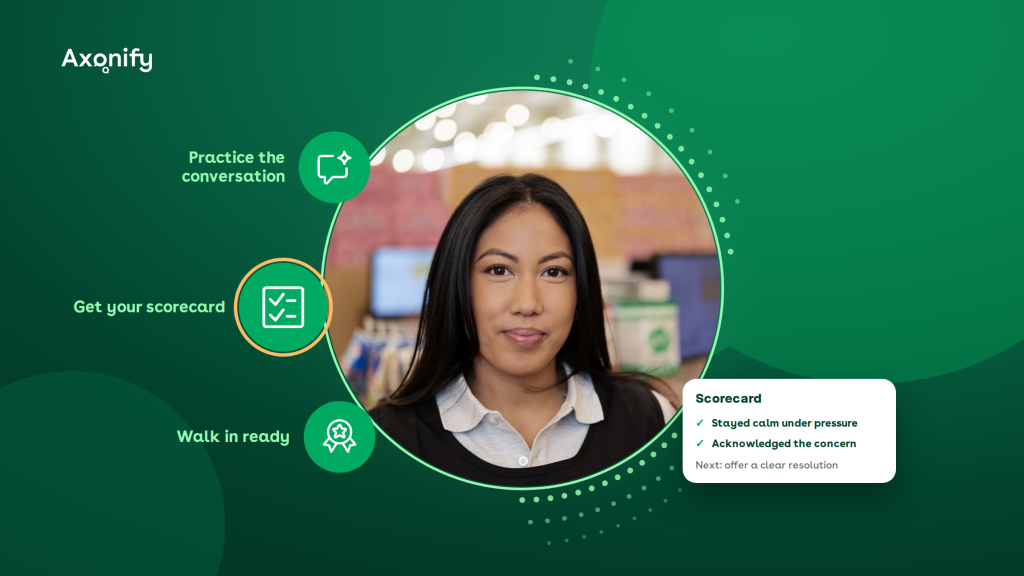
Four AI-powered roleplay conversations frontline leaders are building into their development strategies.
Picture a new hire’s first shift on the floor. They passed the training. They checked every box on the knowledge test. Then a customer walks up, frustrated about a return policy nobody covered, and the employee freezes.
Every frontline leader recognizes this moment. It shows up in a manager who keeps postponing a hard conversation with a direct report, a sales associate who goes quiet the first time a customer pushes back, a new hire who studied the product catalog but never said the words out loud. Training builds knowledge. It rarely builds the muscle memory for turning knowledge into live action, with a real person standing in front of you.
Most frontline training solves for knowledge. Fewer solve for practice and confidence: the repeated, low-stakes reps turning “I learned this” into “I’m ready for this live.” Here are four scenarios worth building into your frontline development strategy, moments coming up again and again on the floor, and what good practice looks like for each one.
Jump to what’s most relevant to your team:
Customer de-escalation: How to stop a customer complaint before it escalates
De-escalation is one of the hardest skills to learn from content alone. Employees learn the steps: stay calm, listen, acknowledge the concern, ask questions, and work toward a resolution. Following those steps while someone is frustrated in front of you is a different skill entirely.
Think about the moments your employees run into on a regular shift:
- A customer challenging a return or refund policy
- An upset customer whose expectations weren’t met
- A service delay someone has to explain on the spot
- A customer asking for an exception the employee has no authority to give
- An interaction needing to go to a manager, and the employee has to decide when
The goal isn’t memorizing a perfect script. It’s giving employees repeated chances to stay composed, listen past the frustration, and make a good call while the conversation is still moving. And the first time an employee tries this shouldn’t be with a real customer standing in front of them.
This is where AI-powered coaching adds a new layer to frontline training. With Max Coach, employees hold a realistic, voice-based conversation with an AI persona responsive to what they say, then get a Scorecard afterward: specific, consistent feedback tied to the same criteria across every associate, every location, every shift. Instead of relying on occasional manager-led roleplay, teams put practice like this in front of every employee, not only the ones a manager has time to coach directly. Consistency like this is hard to get any other way, and it applies well beyond retail: any service-facing team where the volume of live customer interactions makes one-on-one coaching impossible to schedule for everyone stands to benefit.
Difficult conversations: How to help managers practice tough feedback conversations
Not every hard conversation happens with a customer. Some of the hardest ones happen between a manager and their own team.
Think about the conversations quietly piling up on a manager’s list:
- Telling a direct report their performance needs to change
- Addressing a repeated attendance or dress-code issue
- Navigating a sensitive employee concern
- Preparing for a performance review
These conversations rarely get easier by putting them off, and most managers have never had a low-stakes place to practice one before the real thing. This is the gap AI-powered coaching closes.
During the Max Coach Early Access Program, Wayfair used it to give employees exactly this kind of space. “It gives people a safe space to develop, grow and practice harder conversations without feeling like they’re being evaluated,” said Krista Lamproe, Wayfair’s Training Manager for Development and Onboarding. As she put it, “you don’t always have the safety net to practice these hard topics or conversations in real life. That’s what’s so valuable about this platform.”
For employees and managers alike, the payoff is confidence walking into a conversation they’d otherwise avoid or rush. For the organization, it means fewer delayed or mishandled conversations, and a documented way to show development is happening even in moments a training completion report never captures. This use case shows up wherever people manage people, not only in retail.
Building confidence for new hires: How to shorten new hire ramp time with practice
New hires are absorbing product knowledge, processes, policies, systems, and expectations at the same time. Soon, they’re expected to put all of it together in a live interaction. This makes onboarding one of the clearest opportunities to introduce practice.
Start by identifying the conversations a new hire should be able to handle independently before you consider them fully ramped. Depending on the role, this might include:
- Greeting and assisting a customer
- Recommending a product
- Explaining a service or policy
- Handling a common objection
- Responding to a frequently asked question
- Completing a standard service interaction
Then give them opportunities to practice these conversations as part of onboarding, not after onboarding ends.
Getting new hires ready for these moments before they happen live, rather than during it, is where the ramp either speeds up or stalls, and it’s exactly where AI-powered coaching earns its keep. A product sales conversation was one of the first scenarios built for Max Coach, giving new hires a way to work through objection handling and a confident pitch before facing a real customer. Sequenced at the end of an onboarding path, or made available for employees to find on their own, the scenario gives new hires reps they used to only get live, in front of a paying customer.
One L&D leader in the EAP summed up why it works across the employee lifecycle: “I see Max Coach supporting three distinct moments: onboarding, ongoing reinforcement, and just-in-time practice. It can give new hires their first reps, help leaders continue applying what they learned between formal learning experiences, and provide on-demand practice before a real conversation. Three different needs, supported by the same tool.” For new hires, this means walking into their first live interaction having already said the words once. For L&D and operations leaders, it means a faster, more consistent ramp in the roles where turnover keeps restarting it, from retail and telco to automotive service.
Compliance & safety: How to reduce compliance risk with practice before go-live
Some interactions carry more than a service risk. Compliance-sensitive conversations and regulated disclosures are moments where good intentions aren’t the same as getting it right.
Think about the moments where a missed step is the whole problem:
- Walking a customer through a required disclosure, word for word
- Verifying identity or eligibility before completing a transaction
- Following an escalation path exactly as policy requires
- Explaining a regulated process without skipping a step
- Any interaction where “close enough” isn’t close enough
Traditional training helps employees understand what they’re expected to do. Practice gives them a chance to show how they would do it live. Instead of ending a learning path with “Did this employee remember the information?”, organizations start asking, “Does this employee apply it correctly in a realistic situation?”
Scenarios sequenced right after compliance training let employees demonstrate they’ve applied what they learned, with a Scorecard confirming adherence to defined criteria before an employee handles the real situation. This is one way Axonify customers are putting Max Coach to work. What’s already clear from the EAP: a readiness check delivered before go-live, not after a mistake, is the kind of proof point compliance-heavy industries, from telco to financial services, have been asking for.
What makes coaching actually work
Across these four scenarios, the same lesson kept surfacing: for coaching to work at scale, it has to be relevant to the exact job someone does, repeatable without wearing out a manager’s calendar, accessible the moment someone needs it, paired with clear, actionable feedback on what to improve next time, and connected to the learning it follows.
This is the idea behind Max Coach. Because it’s built directly into the platform your frontline teams already use to learn, AI-powered coaching isn’t a separate tool, a new login, or another vendor to manage. A scenario gets built once, sequenced into training, and made available on demand.
Over the summer, organizations across retail, grocery, telco, and automotive tested this during an Early Access Program. They built their own scenarios in Coach Builder, ran their teams through them, and told Axonify what worked and what didn’t. By the end of the program, participants had built 79 coaching scenarios and logged 2,409 practice sessions. Eighty-three percent of learners came back for a second session or more, a strong early signal: employees who try it keep using it.
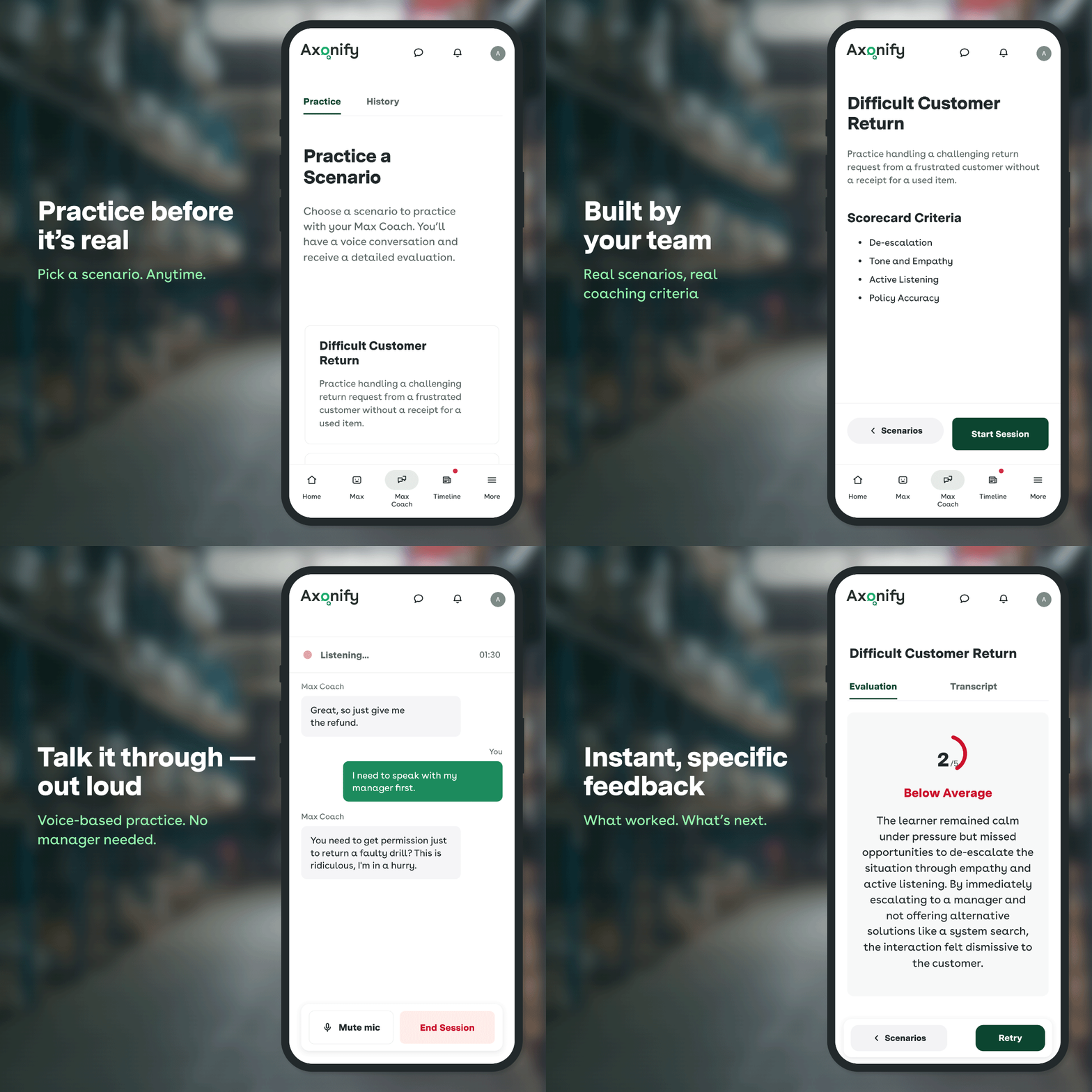
Where AI-powered coaching fits for your team
AI-powered coaching doesn’t replace the manager. It gives managers a better starting point. Instead of spending limited coaching time giving every employee their first opportunity to practice, managers focus on where human coaching has the most value: refining performance, addressing specific gaps, developing top performers, and working through complex situations.
Whether your frontline handles returns, sells a product, walks new hires through their first ninety days, or has to get a compliance conversation exactly right every time, the pattern holds: practice built into the learning your employees already do turns training into readiness.
If you’re an existing Axonify customer, talk to your Axonify representative about exploring Max Coach with your team. If you’re evaluating Axonify, or comparing an AI coach for your frontline employees, ask us what a scenario built for your team would look like, inside the platform your people already use to learn.