Information at their fingertips: The case for AI assistants on the frontline
In this article
A customer asks a question. The new associate doesn’t know the answer. The default has always been the same: find a manager.
That default has a cost. It costs the customer time, standing in an aisle. It costs the associate a hit of confidence, in front of the person they’re trying to help. And it costs the business every single shift, because it doesn’t scale. Put 40 associates on a floor with one manager and “just ask” turns into a queue. Multiply that across a season of new hires and the queue never gets shorter.
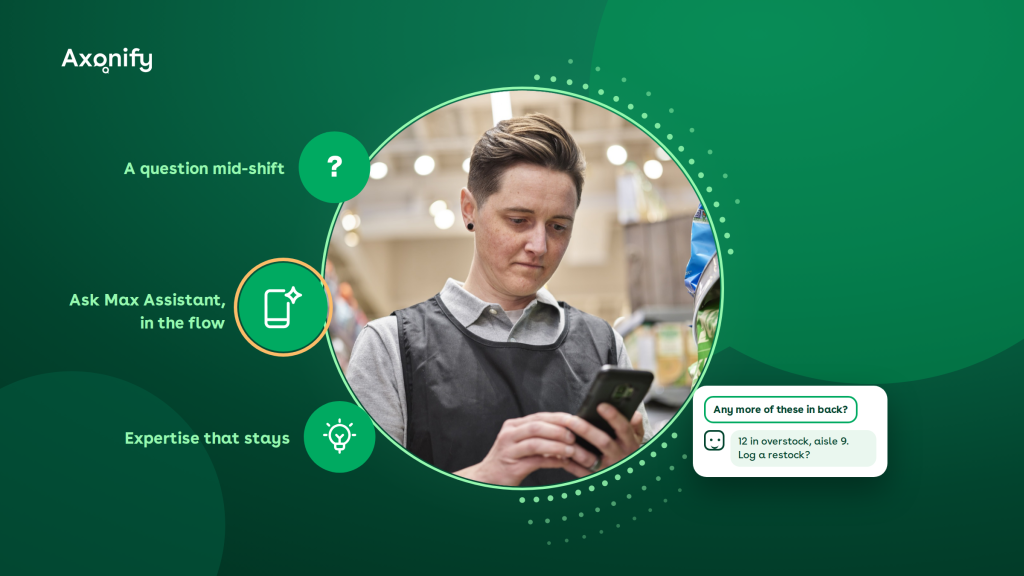
AI assistants embedded in the flow of work change that math. Every associate gets real-time access to institutional knowledge, product information, policy guidance and task support. On their own device. At the moment they need it. Not a binder to consult later. Not a manager to hunt down. An answer, now, so the interaction with the customer keeps moving.
Part of the strategy, not bolted onto it
The mistake to avoid: treating an AI assistant as a standalone solution, dropped onto the frontline and left to run on its own. It has to be part of the holistic learning and enablement strategy. Connected to the same knowledge base. The same reinforcement cadence. The same performance data as everything else associates are learning and doing.
That integration changes onboarding, too. New hires no longer need to be trained on everything they might someday need to know. The long tail of edge cases and rarely-used procedures, doesn’t need a slide in week one anymore. It’s accessible when it’s actually needed. Onboarding can narrow to what’s critical: what’s used every shift. Everything else gets picked up in the flow of work.
That matters most for frontline businesses running high turnover or large-scale seasonal hiring. When product details and policy specifics are one question away instead of one training session away, new hires spend less ramp time memorizing. They spend more time building the judgment and soft skills that actually shape the customer experience. They’re productive sooner. They’re more confident sooner. And the business isn’t re-teaching the same reference material to a fresh wave of hires every few months.
The line between support and a crutch
Here’s where it gets easy to get wrong: giving associates a generic AI chat window and calling it a knowledge strategy. That’s a dumping ground, not enablement. Picture an associate searching the AI assistant for the customer, standing in the aisle while the customer waits. Nothing has actually improved. The manager queue just became a search box.
The goal is different. A frontline AI assistant should build capability, not replace it. Answer the question this time. Reinforce the knowledge behind it. Let the associate answer confidently on their own the next time. Used well, it’s a bridge to expertise, not a permanent stand-in for it. That’s the difference between an associate who searches for the customer and one who delivers an expert experience, unprompted, because the knowledge is now theirs.
What early adopters are seeing
Staples put this to the test. After building trust in Axonify as its frontline platform, Staples introduced Axonify’s Max Assistant, as the next step in frontline enablement. On day one, associates asked Max 2,400 questions. Within three weeks, participation passed 90%. Store task volume dropped 30%.
As Jessica St Jean, Staples’ Director of Sales & Customer Experience, put it: “They felt empowered. They had what they needed right at their fingertips, exactly when they needed it.”
That’s the proof point behind the premise: when associates trust the platform, they use it immediately, and at scale.
Deploying to a workforce that isn’t digital-first
Frontline teams don’t always come in with strong digital habits. That’s the practical question every operator asks before rolling out an AI assistant: how do you get adoption from a workforce used to paper, radios and tapping a manager on the shoulder?
Staples’ path offers a model. Before Max launched, the team spent eight to ten weeks preparing leaders and associates. That groundwork built the trust and habits that made rapid adoption possible once Max arrived. A few principles carry over to any rollout:
Start with leaders, not associates. Store and shift leaders need to trust and use the platform first. Associates follow their lead, not a company-wide memo.
Earn trust before adding capability. Adoption of Max succeeded at Staples because associates already trusted Axonify as their platform for learning and communication. An AI assistant introduced cold, with no existing relationship, has to earn that trust from zero.
Meeting associates where they already are starts with fitting into the device and workflow they use every shift, not asking them to learn a new platform. It also means meeting them in their own language: because Max Assistant supports 60+ languages, it removes language barriers so new hires can get the answers they need and feel confident from their very first shift.
Communicate the why, not just the how. Associates adopt fastest when they understand what the AI assistant replaces—the manager queue, the guesswork—and what it doesn’t replace: their own growing expertise.
It doesn’t need to live in every pocket
Not every organization wants a phone in every associate’s hand. Retailers worry about distraction. Manufacturers restrict devices on the floor for safety. Healthcare systems keep personal phones out of patient-facing areas by policy. That’s a real constraint and it’s not a reason to skip an AI assistant.
Max doesn’t require a personal device to work. It lives wherever the organization already puts a screen: a shared terminal at the register, a desktop in the back office, a dedicated tablet mounted in the stockroom, one shared device passed between shifts. The hardware flexes to the policy, not the other way around.
What matters isn’t the device. It’s the habit. Associates need one clear answer to “where do I go when I have a question”, whether that’s a phone in their pocket or a kiosk by the stockroom. Give them that consistency and the manager queue still empties out, phone or no phone.
The real payoff
Give every associate access to the same institutional knowledge your best associate already carries and the manager queue stops being the bottleneck it’s always been. Do it as part of a real enablement strategy and something better than a faster search happens: associates get more capable every shift, not just more supported in the moment.
And leaders aren’t left guessing either. The Max Summary Report shows where adoption is strong, where content gaps still exist and what to fix next.
Information at their fingertips today. Expertise in their hands tomorrow. That’s the case for AI assistants on the frontline.
Learn how Axonify and Max Assistant bring
institutional knowledge to every shift.