Grocery loyalty is up for grabs. New Axonify research reveals how stores can win.
Grocery shoppers are changing the rules of loyalty. And for grocery retailers, that presents an opportunity hiding inside a challenge.
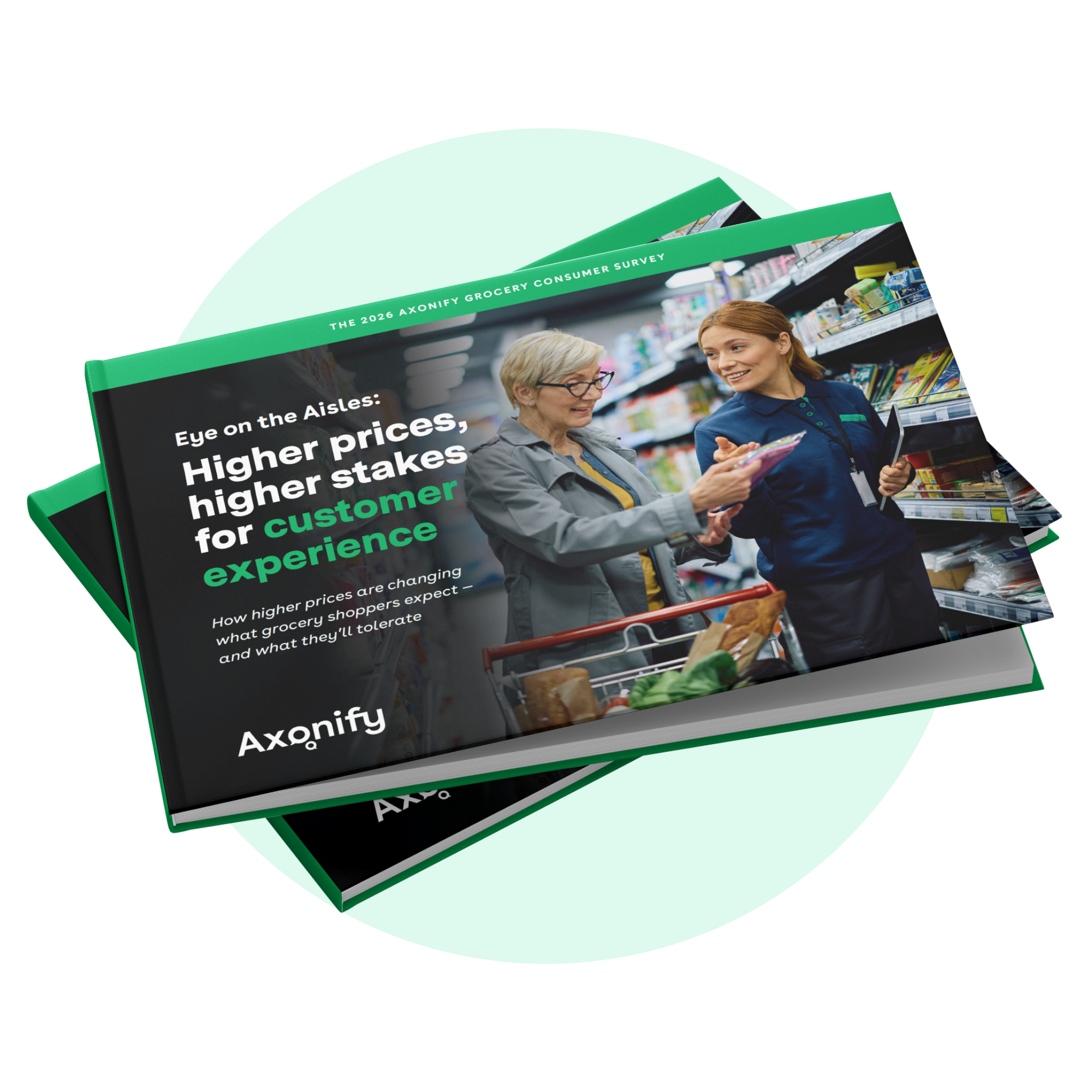
According to Axonify’s new Eye on the aisles: Higher prices, higher stakes for customer experience report, 88% of grocery shoppers now visit more than one store in a typical month and 42% have reduced visits to a store they once frequented regularly.
Price is driving much of that behavior. But the research reveals something more interesting: While shoppers are increasingly focused on how much they spend, they’re also paying closer attention to what they get in return.
In this article
Higher prices are raising expectations, not lowering them
Based on a survey of 1,251 U.S. and Canadian grocery shoppers, Axonify’s research reveals what we call the Price-Experience Paradox: As consumers become more price-conscious, they become less tolerant of disappointing shopping experiences.
While 92% say grocery prices have risen over the past year, 58% say a poor in-store experience is extremely or very frustrating now that prices are higher and 42% notice problems in stores more than they used to.
And while competitive pricing tops the list of what shoppers say matters most, the factors most closely associated with a positive overall experience tell a different story. Product quality and freshness, cleanliness, store atmosphere, selection and friendly, knowledgeable employees all show stronger relationships with overall satisfaction than price.
Even among households earning less than $50,000 annually, 47% say they would pay more for a noticeably better grocery experience, compared with 44% of shoppers overall.
Price sensitivity doesn’t mean consumers are willing to accept a lesser experience. Value isn’t simply the number on a price tag. It’s the total experience a shopper receives for the money, time and effort they invest.
Loyalty is won in everyday store operations
Among shoppers who reduced visits to a particular grocery store, 26% cited a better overall experience elsewhere, 26% cited long checkout lines and 23% cited out-of-stock products.
These frustrations represent smaller, everyday factors that become much more consequential when customers are already feeling the pressure of higher prices.
And many of them are directly influenced by the frontline workforce.
Customers notice whether employees are friendly, knowledgeable and available to help. But they also notice the experience employees create behind the scenes: stocked shelves, fresh products, clean aisles, accurate signage and an organized store that’s easy to navigate.
The challenge for retailers is delivering those experiences consistently, especially when margins are tight and employee turnover is high.
Cutting labor costs may seem like a straightforward way to protect margins. But if those cuts result in longer lines, emptier shelves or less help available to customers, the savings can come at the expense of future loyalty.
The better opportunity is to find efficiencies that improve frontline training and performance rather than compromise it.
Frontline readiness is the next competitive advantage
Retailers have become incredibly sophisticated at measuring sales, inventory and customer behavior. But as the grocery shopping experience becomes an increasingly important driver of loyalty, there’s another question operations leaders should be asking:
How prepared are our employees to deliver the experience customers expect?
That requires looking beyond whether employees have completed training or received a communication. Do they understand their priorities? Can they confidently answer customer questions? Do they know how to respond when checkout lines build or shelves are sparse?
Short, continuous learning, AI-powered coaching and better access to information can help employees build confidence and execute consistently, while giving managers more time to focus on developing their teams.
At Axonify, we believe closing the gap between learning and execution is essential to helping frontline teams perform at their best. Customer experience isn’t just a promise made by a brand–it’s a promise fulfilled by the people representing it every day.
The opportunity ahead
The implications extend well beyond today’s shoppers. Among Gen Z consumers, 57% say they would pay more for a noticeably better grocery experience, the highest of any generation surveyed. As their purchasing power grows, retailers that establish relationships with these shoppers could pay dividends for decades.
Not every grocer can win a price war. But every retailer can compete on the quality and consistency of the experience it delivers.
Price may determine where shoppers go first. But experience can determine where they choose to go next.
And increasingly, that’s where grocery loyalty will be won.
Download the full Eye on the aisles 2026 grocery consumer report to explore the findings and what they mean for frontline operations and customer loyalty.