Competency assessment: A smarter way to build readiness and performance

Most competency assessments slow people down. They test what workers already know instead of helping them apply it. But for businesses that rely on the frontline, the goal isn’t just to measure capability—it’s to accelerate it.
Today, competency assessment can’t just be a checkbox. It needs to equip frontline employees with the skills, knowledge and confidence they need to deliver a consistently great customer experience.
In this article, we’ll explore where traditional competency assessments fall flat, what kinds of assessment frontline employees need to perform their best and how to implement a modern approach that saves time, keeps staff engaged and delivers measurable ROI.
What is a competency assessment?
A competency assessment is a way of measuring whether an employee has the skills, knowledge or behaviors to perform their job effectively. Companies can use them in the hiring process to determine whether an individual is a good fit for a given role, or as a performance evaluation tool for existing employees.
They can be frequent or infrequent, long or short—if it’s a method of workplace skills validation, it counts as a competency assessment.
Competence vs. competency—and why both matter
Though they sound similar, competence and competency aren’t quite the same thing. Let’s break it down:
- Competence: A specific skill that someone has.
- Competency: The ability to apply that skill consistently.
For instance, you can be considered to have a competence in food safety if you’ve attended a training session, but you only have that competency if you can consistently set up and maintain a safe and hygienic food handling environment. See the difference?
Competency assessments have been traditionally used to evaluate competence more than competency. But that leaves a gap between what’s being assessed and what organizations really need from their frontline workers. Let’s see what traditional assessments miss and why more and more organizations are moving toward a continuous improvement model.
Competency assessments back then: The snapshot model
Traditionally, companies use competency assessments to capture a snapshot of an employee’s skills and abilities, often as part of hiring, onboarding, or compliance processes. For instance, giving a written test to new restaurant serving staff that they have to pass before they’re allowed to work on the floor on their own.
The problem with a snapshot like this, however, is that it can’t show the complete picture. It just captures a small part, at one moment in time. If you’ve ever crammed for a test only to forget what you studied right after, you know that a one-off evaluation is not an effective way of measuring your real skills.
Instead, it’s better to practice and quiz yourself on your knowledge regularly, in bite-sized chunks. The same goes for the key skills your employees need to know. (That’s called microlearning and it’s proven to help teams retain information better, especially when reinforced at regular intervals.)
That’s why we’re seeing a shift from one-off assessments to continuous improvement.
Competency assessments now: Continuous improvement
Today, leading frontline organizations are focusing on steady, consistent assessment. This not only leads to better learning outcomes, but also allows companies to continuously integrate new training as best practices change in their industries.
It doesn’t have to be a huge time commitment—having your team spend 3-5 minutes a day reviewing and testing their retention of key material keeps that knowledge fresher than spending a few hours in mandatory training once a month.
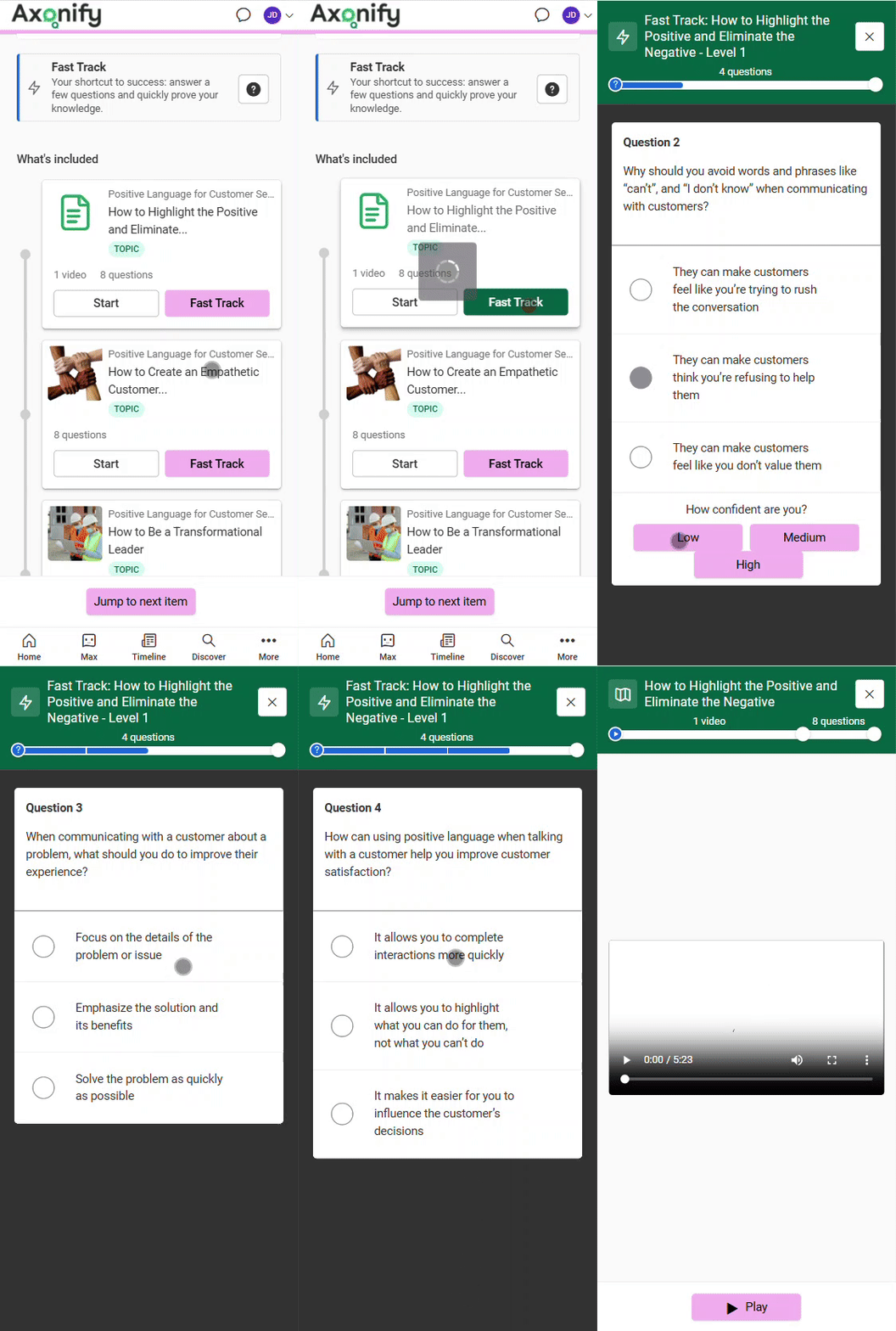
To get the most out of these daily review sessions, your staff needs to address their knowledge gaps—not just cycle through material they already know well. With Axonify, your frontline staff can use the new Fast Track feature to “test out” of content they’re already proficient in, so they get straight to the good stuff.
And, when they need quick answers to their questions, Max, Axonify’s AI assistant, is there. Employees can ask Max questions and it’ll surface the relevant information, without them having to go back and comb through their training materials.
Together, Fast Track and Max act as a powerful duo for organizations focused on continuous improvement—allowing staff to get the most out of their training without disrupting the flow of work.

Watch how Fast Track lets learners validate what they know and skip redundant modules, helping them cut training time and boost productivity.
Why competency assessment matters now more than ever
Frontline industries are under immense pressure to do more with less. Performance expectations haven’t shifted, even as industries face big challenges like sky-high annual turnover (in hospitality, it’s almost 70%) and rising costs due to inflation and tariff impacts.
You can’t afford to take staff off the floor for lengthy training sessions. And you need to get new hires up to speed quickly so they can start contributing meaningfully—and don’t become a compliance risk. Plus, you need to be able to quantify the impact of your learning strategy so you can prove the ROI in training. No pressure.
That’s where an effective competency assessment strategy comes in. The right approach will help bring down costs, speed up onboarding, lead to better employee proficiency, improve customer experience and increase ROI. Here’s how:
Accelerate your onboarding and time to proficiency
Today’s frontline employees need to be on the floor as soon as possible, not wasting valuable time sitting through training videos. That’s where Fast Track comes in. Experienced staff can “test out” of content they already know, helping them stay engaged and quickly become productive.
Identify and quickly close skill gaps
In frontline work, even small mistakes can lead to an inconsistent brand experience, disgruntled customers and bad reviews. Regular competency assessments reveal these gaps before they affect performance, giving managers the chance to step in and ensure their staff are equipped to do their best work.
Link training to measurable ROI
To ensure your training is effective, you need to be able to link it to measurable performance outcomes. Fast Track Report quantifies time saved, pass rates and proficiency, turning training into actionable business intelligence.
Enable continuous access to knowledge with AI
Being taught a best practice in training isn’t the same as being able to do it on the job. Luckily with Max, employees can search SCORM and internal content instantly to get answers when they need them—reinforcing key skills in the moment.
The most common types of competency assessments (and their gaps)
Competency assessments come in all kinds of different forms. The most common types provide a “snapshot model”—demonstrating an employee’s knowledge at one moment in time, but not day-to-day execution or retention.
Here are the ones you’re most likely to encounter:
Self-assessments and manager evaluations
Probably the most common type of competency assessment, self-assessments and manager evaluations provide a formal, written assessment of an employee’s performance, typically on an annual or semi-annual basis.
While useful for self-reflection and performance conversations, these kinds of assessments are often quite subjective and inconsistent. The validity of self assessments are especially difficult to prove, since employees tend to be biased in favor of their own strong performance.
▶️ Also read: 30 essential performance metrics for frontline employees
360-degree feedback
An increasingly popular option, the 360-degree feedback process democratizes performance reviews by collecting confidential reports from an employee’s colleagues, manager(s) and any direct reports to compile a more comprehensive picture of their performance.
This model has the benefit of providing much more peer accountability, but still over-relies on someone’s perception among their team, not proof of actual workforce readiness.
Skill and knowledge tests
Typically integrated at the end of a training module, skill and knowledge tests can capture an employee’s understanding at a specific moment in time. That said, these kinds of assessments do little to show long-term retention, skill acquisition or behavior change.
▶️ Related: Skill development examples: 15 essential skills and how to build them
Scenario-based or behavioral interviews
Most commonly used within the hiring process, scenario-based interviews assess how an employee would make a decision when faced with a particular situation (for instance, an irate customer). This can help reveal their thinking and decision-making skills, but only in isolated, theoretical contexts.
Project or portfolio assessments
While less common in frontline industries, project or portfolio assessments can also be used to evaluate an employee’s work quality, especially in the hiring process. These capture specific project outcomes, but don’t do a good job of accurately measuring in-the-moment performance or confidence.
All of these methods capture employee knowledge. Where they fall short, however, is accurately measuring how an employee is actually performing day-to-day, not just in one specific evaluation. Modern competency assessment systems close that gap.
The modern approach: Adaptive competency assessment
To be effective, training and assessment can’t just be one and done. Modern teams need personalized, consistent learning and assessment that adapts with them to reinforce knowledge and readiness.
With Axonify, adaptive learning, continuous reinforcement and AI intelligence join forces to create a living competency framework that scales with your business. Here’s how:
Fast Track your team through the content they know
There’s nothing worse than sitting through mandatory training you could recite in your sleep. That’s why we provide the option for employees to prove what they know through quick test-outs. Admins decide what content is eligible, so you can maintain compliance while saving time.
Continuously reinforce key learning to ensure nothing slips
A little practice every day adds up. Axonify’s reinforcement engine, grounded in brain science, strengthens memory and behavior within 30–90 days—keeping critical knowledge fresh and active.
Build personalized learning paths
No two employees are alike—and neither should their training be. Fast Track tailors training to individual strengths and gaps, replacing one-size-fits-all training with targeted upskilling. So your team makes progress on what matters, faster.
Access real-time knowledge with Max
Most training relies on employees remembering the right steps to take, often in the middle of a stressful moment. Max gives them an AI learning assistant in their pocket to surface SOPs, policies and resources right when they need them most. So frontline workers can ask questions like, “How do I handle this safety issue?” and receive an immediate, compliant answer.
Measure readiness—not just completion
Assessment isn’t just a box-ticking exercise. It’s the constant, ongoing process of living up to your brand promise. With Fast Track Report, you can visual key metrics like time saved, proficiency rates and topic adoption—helping learning and development, human resources and operations team prove the ROI on their training.
How to design a modern competency assessment
Modernizing your competency assessments is the best way to reap the benefits of continuous, adaptive learning. Below, we’ll walk you through exactly how to do it.
Step 1: Define role-based competencies
First, define what success looks like for each frontline role. Link these key competencies to business KPIs.
Step 2: Personalize and automate learning paths
Next, assign training based on performance, confidence and role needs. Leverage analytics to help personalize paths—the more data you collect over time, the better your recommendations will be.
Step 3: Empower employees with adaptive and AI-enabled tools
Enable your frontline staff to take charge of their own learning journeys through tools like Fast Track for knowledge validation and smart assistants like Max.
Step 4: Reinforce and measure performance over time
Track your team’s progress through Axonify analytics. Pay special attention to knowledge growth, confidence trends and readiness indicators to see how employees are developing in real time.
Step 5: Translate data into action
Finally, continue to tweak content and prioritize key development areas. Use your metrics and insights from Fast Track Report and Max search trends to continue to evolve your training and competency assessments to fill knowledge gaps and meet business needs.
Fast Track in action: Accelerating readiness in supply chain
For one major supply chain retailer, Fast Track became a turning point in how they measure and accelerate workforce readiness. By allowing experienced employees to demonstrate what they already know, the company streamlined training, improved engagement and saved valuable hours across the network.
“Fast Track is a valuable tool that saves time and improves training efficiency. It helps filter out people who already know the content, leading to a more engaged training session for those who need it. We’ve seen an average of an hour of time saved for every one of those employees—and that’s just the beginning.”
— Supply Chain Training Manager
The retailer also found that Fast Track encouraged employees to take ownership of their learning.
“Fast Track has been a huge hit with our team. They were excited to test their knowledge and many scored 100%. It helped build confidence in topics like change management — where knowing about it and understanding it can be two different things.”
— Supply Chain Training Manager
And the benefits extended beyond engagement. The company discovered a clear link between learning participation and retention — particularly among new hires.
“It’s really cool to see a direct correlation between a new employee’s knowledge growth and their team’s retention. Focusing on building knowledge in the first 90 days can be a significant factor in improving employee retention.”
— Supply Chain Training Manager
Common competency assessment challenges (and how to overcome them)
Organizations looking to implement a modern, continuous reinforcement approach to training their frontline teams face numerous challenges.
Luckily, Axonify anticipates and solves these challenges with its science-backed learning platform. Here’s how:
| Challenge | How Axonify solves it |
|---|---|
| Training is redundant or time-consuming | Fast Track lets employees test out and focus only on what’s new. |
| Readiness varies across locations | Daily reinforcement ensures consistent SOP execution. |
| ROI is difficult to measure | Fast Track Report quantifies time saved and proficiency improvements. |
| Knowledge deteriorates after training | Max delivers just-in-time answers in the flow of work. |
| Staff show low engagement | Gamified reinforcement builds daily training habits. |
From competency to capability: The future of workforce assessment
Frontline excellence isn’t achieved through static assessments but built through continuous capability. Axonify helps organizations move beyond testing and tracking knowledge to actually building and sustaining performance. Adaptive, AI-enabled and measurable, Axonify connects training, reinforcement and on-the-job support to drive lasting readiness and measurable business impact.
Adaptive learning makes static assessment a thing of the past
Axonify’s dynamic approach to training evolves automatically with each user. As employees demonstrate knowledge and performance, the platform adjusts content to focus on what matters most—closing knowledge gaps faster and reinforcing core competencies over time.
AI intelligence keeps key performance criteria within reach
With Max, Axonify’s AI assistant, employees can instantly surface SOPs, policies and answers in natural language, reinforcing the right behaviors and maintaining compliance in the moment of need.
Data closes the loop between workforce readiness and ROI
Through Fast Track Report and analytics, leaders can quantify time saved, pass rates and proficiency gains, linking every training moment to productivity, safety and other key P&L metrics.
Together, Fast Track + Max redefine readiness
Axonify empowers employees to take charge of their own development. With Fast Track validating what they already know and Max delivering instant access to what they need next, the frontline continuously learns, adapts and performs all within one seamless ecosystem.
Key takeaways
Frontline capability isn’t built in a classroom. It’s strengthened every day through continuous training, reinforcement and application on the job.
- Readiness is continuous. Modern organizations are moving beyond one-time assessments to adaptive, ongoing learning that evolves with each employee.
- Fast Track accelerates proficiency. Employees validate existing knowledge and focus training time where it matters most, boosting efficiency and engagement.
- Max powers on-demand support. With AI-driven answers in the flow of work, employees can reinforce key skills and stay compliant without slowing down operations.
- Data connects learning to results. Through Fast Track Report and analytics, leaders can visualize time savings, proficiency growth and ROI across the organization.
- Capability drives performance. Together, Fast Track and Max turn learning into readiness and readiness into measurable business results.
When every employee is equipped, confident and supported in the moments that matter most, your organization becomes not just competent but truly capable.
From competence to confidence
The moment training matters most isn’t in a test scenario—it’s when an employee is in the middle of a key task or critical customer interaction. Testing shows that your staff can get it right in an isolated instance. Daily practice with Axonify trains your team so they can’t get it wrong.
Axonify’s platform turns knowledge into readiness and that readiness into measurable business performance. Because when your customers consistently get a great experience, you build loyalty and trust.
Discover how Axonify can make your frontline faster, smarter and more productive—so your people stay customer-ready, every day.
Ready to accelerate frontline readiness?
See how Fast Track and Max work together to help your people learn smarter, perform faster, and stay customer-ready—every day.