LMS evaluation guide: How to choose a Learning Management System

In this article
Choosing a Learning Management System (LMS) is a strategic decision. It directly impacts how your teams learn, perform and adapt.
With the LMS market expected to grow to $51.9 billion(US) by 2028, the sheer number of vendors, features and promises can make the selection process feel overwhelming. But not all LMSs are built to drive real business outcomes.
That’s especially true for organizations with frontline workforces. Many traditional platforms were designed for office-based employees, not for people who spend their days on the floor, in the field or behind the counter. If learning is hard to access, disconnected from day-to-day tasks or doesn’t reflect how frontline teams operate, it simply won’t stick. And that can lead to gaps in knowledge, performance, safety and retention.
Whether you’re selecting your first LMS or upgrading from a legacy platform, this guide walks you through a phased evaluation process to help you make a confident, future-ready choice—one that meets both your learner needs and your business goals.
1. Start with a phased LMS evaluation process
Jumping into demos or feature comparisons too early can lead to decision fatigue, or worse, the wrong fit. A structured LMS evaluation keeps your team aligned, focused on outcomes and better prepared to choose a platform that works today and scales with your business tomorrow. Breaking the process into clear phases helps you move with confidence and avoid costly missteps down the line.
Here’s how to structure your LMS evaluation:
- Assemble your team: Start by assembling a cross-functional group that reflects your organization’s learning landscape. Include L&D leaders, IT and HR partners, frontline managers, instructional designers and—importantly—your frontline employees. Their input is essential for identifying must-have capabilities and ensuring the platform will actually work in real-world conditions, not just in theory.
- Conduct a needs analysis: Don’t shop before you’re clear on what you need. Clarify your business goals, define your learning objectives and identify the specific learner groups you’re designing for. For frontline teams, that may include deskless workers who need quick, mobile access to training during shifts. Map out your current tech stack, content inventory and any friction points in your existing learning workflows.
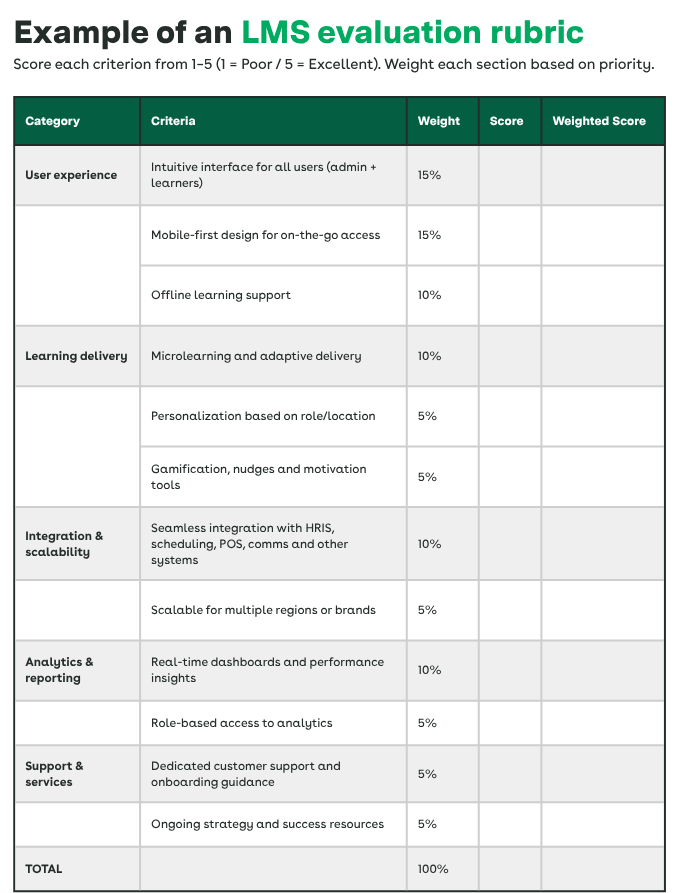
- Build your LMS evaluation checklist and rubric: Translate your needs into an actionable checklist. Go beyond a generic list of features and instead prioritize capabilities based on real use cases. For frontline-focused organizations, that might include mobile-first design, microlearning, offline access, native integrations with workforce tools and automated reporting. Assign weights to each item in your rubric to keep comparisons objective.
- Drive a collaborative decision-making process: Once you’ve shortlisted vendors, involve your stakeholders early and often. Book tailored demos, ask each vendor to walk through key scenarios based on your rubric and let different team members score solutions from their perspective. A collaborative process ensures the final decision isn’t just convenient or budget-driven but built around the everyday needs of your people.
2. Define learning needs with real-world context
Every organization has different priorities. A retail team ramping up for holiday seasonality won’t have the same needs as a manufacturing team focused on safety compliance. That’s why your LMS must reflect the specific context in which your people work—not just now, but as your business evolves. The better you define those needs upfront, the easier it is to find a platform that fits.
Start with these foundational steps:
- Identify learning objectives and target audiences. For example, frontline workers need quick, mobile-first training that they can access on shift, while desk-based employees might need longer-form modules with progress tracking and certification.
- Map out key use cases: Consider common learning scenarios like onboarding seasonal staff, maintaining compliance across locations or reinforcing SOPs through short, repeatable modules.
- Understand growth and scalability needs: Anticipate shifts like headcount growth, high turnover, multilingual learning needs or expanding to new business units.
- Evaluate technical ecosystem fit: Your LMS should plug into existing tools like HRIS, payroll and scheduling platforms to reduce duplicate work and simplify workflows.
3. Create a detailed LMS feature checklist
Once you know what your organization needs, shift your focus to features that enable those goals. A detailed feature checklist can help you look past surface-level differences and stay grounded in what really matters: business impact and usability.
Use a scoring rubric to evaluate:
- Learning experience and engagement: Features like microlearning, gamification and adaptive content help people stay motivated and retain knowledge longer.
- User experience and usability: Learners need a simple, frictionless interface. Admins should be able to author, schedule and assign content without needing IT support.
- Assessments and reinforcement: Look for tools that support confidence-based learning, spaced repetition and different quiz formats. These help build lasting knowledge, not just pass-fail results.
- Integrations and automation: Built-in connections to HR systems, content libraries and communication tools streamline admin time and keep records synced.
- Reporting and analytics: Real-time dashboards and outcome-linked metrics let you connect training to KPIs like productivity or customer satisfaction.
- Compliance and risk tracking: Tools that automate reminders, manage certifications and provide audit trails are essential for regulated industries.
- Support and vendor services: Ongoing support, onboarding services and a proactive customer success team make a big difference post-implementation.
- Total cost of ownership: Include indirect costs like IT overhead, time spent maintaining content and future upgrade fees, not just license costs.
🎯 Want expert help building your LMS checklist?
The Axonify Advantage Program gives you direct access to implementation experts, industry benchmarks and proven strategies—so you can confidently evaluate vendors and build a smarter learning ecosystem from day one.
4. Compare costs and model ROI
LMS pricing can vary dramatically, but cost alone doesn’t tell the full story. What matters most is return on investment: how much value your business gains from each dollar spent. That starts by modeling both current costs and future savings.
- Audit your current costs: Include licensing, support, content creation, admin hours and training time. This gives you a realistic baseline.
- Project potential savings: Estimate how much you could save through reduced onboarding time, fewer compliance incidents or improved performance. For instance, if new hires hit full productivity two weeks sooner, what’s that worth?
- Use a weighted scoring model: Combine price with feature value, business fit and support to choose a platform that offers lasting return, not just a lower line item.
5. Evaluate learning impact and engagement
The best LMS platforms don’t just deliver training—they drive measurable behavior change. That means you need more than login counts. Look for signals that show learning is working in the flow of work and delivering real outcomes.
- Engagement metrics track completion rates, repeat logins and mobile usage to see if people are actively engaging.
- Behavioral impact: Monitor business KPIs related to learning, such as faster onboarding, reduced safety incidents or better customer ratings.
- Content retention: Use spaced learning and short reinforcement quizzes to ensure learners retain knowledge over time.
- Performance insights: Choose a platform that links training data to outcomes, with clear dashboards for leaders and frontline managers alike.
6. Gather input from learners and admins
LMS decisions are often made at the top—but the people using the system every day have the clearest view of what works. Getting their input ensures the platform you choose fits their reality, not just your wishlist.
- Survey learners and admins: Ask how easy the system is to use, how relevant the content feels and what common pain points exist today.
- Run small focus groups: Talk to people across teams or roles. A restaurant server, for example, might prioritize speed and mobile access, while a district manager may care more about reporting and compliance.
- Use in-platform feedback tools: Many LMSs offer built-in surveys or rating systems that can capture user sentiment in the moment.
7. Test platforms with real users
A pilot helps you go beyond marketing promises and see how a platform performs in your environment. It’s your best shot at reducing the risk of buyer’s remorse and building confidence in your final choice.
- Request customized demos: Ask vendors to walk through scenarios relevant to your business, like launching a safety course across multiple locations.
- Run a pilot with actual users: Choose a group that represents your broader workforce. Test both the learning experience and the admin functionality.
Score pilot results: Use your scoring rubric to assess usability, content delivery, engagement and reporting during the pilot window.
8. Confirm long-term readiness and innovation
Choosing a platform isn’t just about solving today’s challenges. It’s about ensuring your LMS can scale and evolve with you, without requiring a costly replacement in a few years.
Look for platforms that:
- Use AI and automation to personalize learning: Features like adaptive pathways or automatic nudges help individualize the experience at scale.
- Support new formats and delivery models: Mobile-first learning, just-in-time resources, peer learning and built-in comms tools are becoming table stakes.
- Offer regular updates and innovation: Ask about the product roadmap and how often new features are released. A stagnant platform is a risk.
- Enable agility at scale: Whether you’re onboarding 1,000 seasonal hires or adapting to new compliance rules, the platform should keep up without breaking workflows.
9. Finalize your decision using data and feedback
At this stage, you’re not just picking a vendor, you’re making a strategic investment. Your final decision should be grounded in data, aligned with stakeholder input and built to hold up under scrutiny.
- Compare vendors side-by-side using your weighted rubric: This keeps the process transparent and tied to your original goals.
- Involve your full evaluation team: Cross-functional input ensures you haven’t missed key needs or underestimated future complexity.
- Ask for final references or case studies: Confirm that the platform performs in environments similar to yours. A logistics company, for example, might want to hear from other distributed, high-turnover teams.
- Document your final choice: Write up the rationale behind your selection. This helps with internal buy-in, change management and makes it easier to revisit the decision later if needed.
A smarter LMS evaluation leads to smarter results
A strategic LMS evaluation helps you align learning tools to real business needs—reducing risk, improving outcomes, and setting your organization up for long-term success. By evaluating features, cost, experience and impact through the lens of your people, you’ll choose a platform that delivers more than content—it delivers performance.
Axonify’s LMS advantage
Axonify is purpose-built for frontline success. With personalized, mobile-first microlearning, embedded reinforcement and clear behavior tracking, Axonify helps organizations train in the flow of work—where it counts. Learn why more than 4 million frontline employees use Axonify every day.